Inside Abu Dhabi’s AI-Powered Life Sciences Ecosystem
Key Takeaways
- Abu Dhabi is becoming an AI healthcare hub, driven by DoH, M42, G42 Healthcare, and strong government investment.
- Diagnostics, genomics, digital health, and drug discovery are the biggest opportunities for health-tech companies.
- Secure, compliant AI architecture is essential, with UAE data residency, clinical validation, and strong governance built in from the start.
- Arabic-English support and legacy integration are critical for successful healthcare AI deployments in Abu Dhabi.
- Early market entrants can gain an edge by partnering locally and building compliance, interoperability, and scalability into their solutions.
Introduction
Abu Dhabi has quietly emerged as one of the most watched life sciences markets in the world. The emirate is testing a fully AI-native healthcare system at a national level, with sovereign funds, a single healthcare regulator and integrated players such as M42 and G42 Healthcare. Suppliers looking at AI healthcare solutions Abu Dhabi will find the opportunity is about more than discrete pilots – it’s about diagnostics, genomics, drug research and digital infrastructure. In this article, we’ll examine the drivers of that growth, the opportunities for health-tech companies, the technology stack in play, the compliance challenges, and a practical road map for entering the space.
Why Abu Dhabi Is Becoming an AI Healthcare Hub
Abu Dhabi healthcare innovation did not happen by accident. The Department of Health (DoH), the emirate’s sole healthcare regulator, has spent the last several years digitizing core services and combining that digital backbone with AI-use-case advisory work through partners such as Accenture. Meanwhile, M42, the integrated health company formed by G42 Healthcare and Mubadala Health, has taken clinical AI to production, including its Med42 clinical language model, built for use at the front line of medicine.
The UAE’s digital health transformation is characterized by a combination of centralized legislation, government funding and applied AI that sets it apart from slower-moving markets. It’s part of a broader UAE AI strategy, where healthcare technology UAE is a national priority, not a side experiment. That’s why vendor interactions here move faster once the needed regulatory links are in place.
Key Pillars Driving Abu Dhabi’s AI Healthcare Growth
The momentum for AI healthcare in Abu Dhabi is built on four pillars, each supported by a different combination of government funding, academic research and clinical implementation. Each has its own stakeholders, data flows and procurement dynamics, which impact everything from regulatory talks to partnership strategies. Knowing what pillar a vendor product falls into is key.
1. AI-Powered Diagnostics
Radiology, pathology and early-screening procedures are the most sophisticated entry points for AI in Abu Dhabi’s health care system. DoH-affiliated providers and M42 assets are testing out AI-assisted imaging review to help reduce turnaround times and identify issues that a busy radiologist on a shift might otherwise miss, but not to remove a radiologist from the final call.
2. Genomics and Precision Medicine
The pillar is supported by the Abu Dhabi Biobank, a joint initiative between the Department of Health and M42 to collect biological, genomic and clinical data for research and preventive care. A 2026 partnership with BioTwin to deploy AI-enabled Virtual Human Twin modeling for multi-cancer screening exemplifies the convergence of genetics and AI for population-level precision medical technologies, starting in oncology and spreading to other disease areas.
Hospitals, insurance, and government agencies are linked through patient portals, remote monitoring and integrated health records. These healthcare research platforms are increasingly built on common data standards, which means that a diagnosis made in one facility can inform care throughout the network, rather than being siloed in a single provider’s records.
4. AI Drug Discovery and Biotechnology
DoH has collaborated with Khalifa University, Illumina, PureHealth and NYU Abu Dhabi on a precision-medicine project in oncology, rare genetic illnesses, and metabolic disorders. This study is the foundation of pharmaceutical AI solutions that are putting Abu Dhabi on the map for true AI biotechnology UAE competitors, with academic and clinical partners feeding real patient data back into the research pipeline, instead of working only with synthetic datasets.
Turn Abu Dhabi’s AI Healthcare Opportunity into a Scalable Platform
Major AI Opportunities for Health-Tech Vendors in Abu Dhabi
There are many opportunities for vendors in the pillars above but they are not all the same. Here are four areas where international and regional health-tech startups are already finding the shortest path to paid deployments, each with its unique customer profile, integration requirements, and competitive landscape.
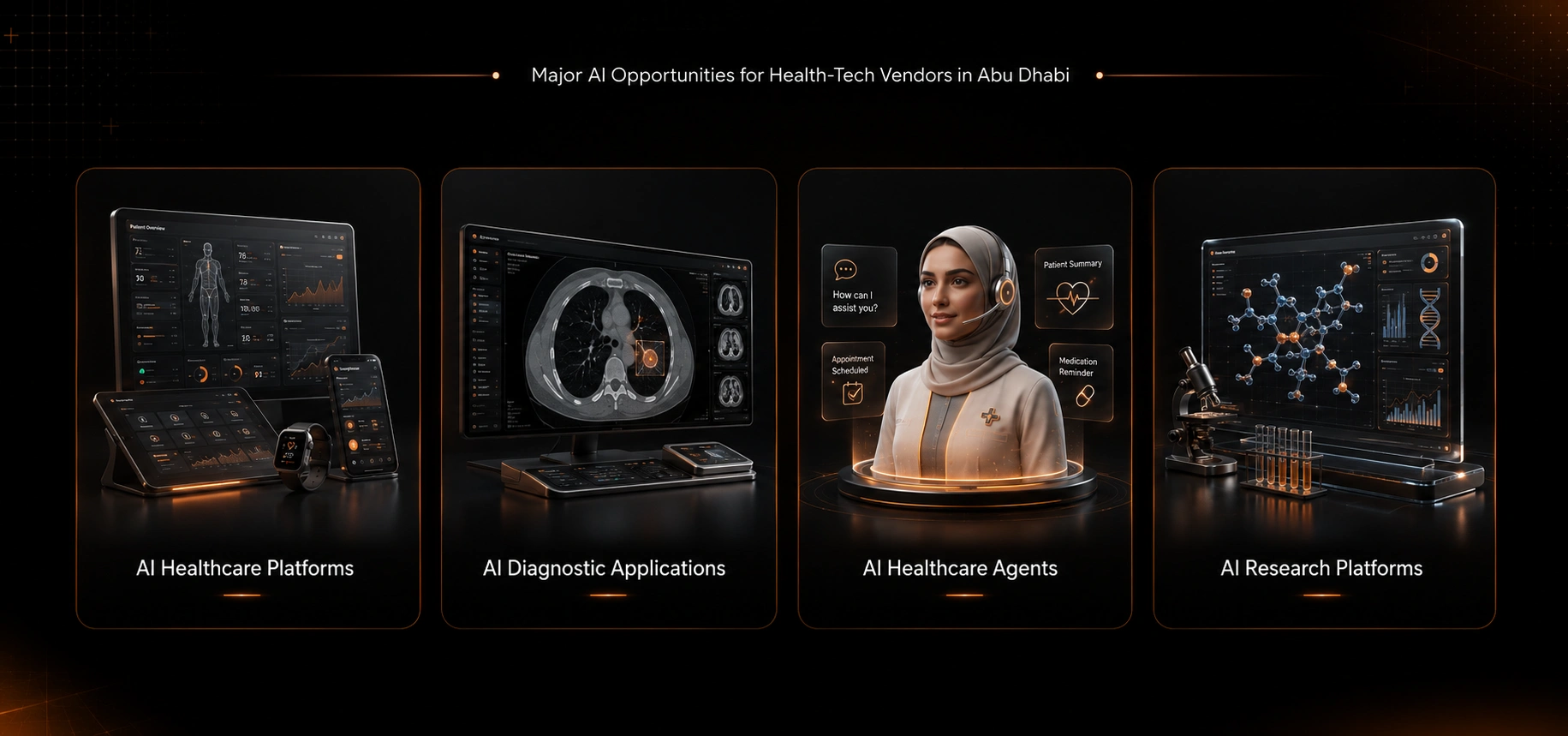
Most providers now are cobbling together these elements from different systems, so vendors who can deliver AI healthcare platforms for scheduling, triage and care coordination have a clear opportunity. Here is where the opportunities are concentrated:
- By layering predictive healthcare analytics on top of a hospital’s existing data you add value without having to completely rebuild the infrastructure and shorten sales cycles.
- Care coordination technologies to standardize scheduling, triage and follow-up across departments.
- Patient engagement technologies that inform patients between visits without adding to staff workload.
2. AI Diagnostic Applications
Beyond imaging, there is an opportunity for AI medical solutions in dermatology screening, test results analysis and early sepsis or deterioration alarms, with the same regional healthcare investment momentum that PwC has seen across the Middle East. These solutions provide AI clinical decision support, not autonomous diagnosis, which is important for both regulatory approval and professional trust.
3. AI Healthcare Agents
Healthcare automation systems such as virtual nursing assistants, appointment triage bots and medication adherence agents can help ease the burden on workers during peak hours. Vendors with extensive experience in AI chatbot development are well positioned here, provided the agents seamlessly interact with Arabic and English clinical workflows, rather than adding one language as an afterthought.
Abu Dhabi’s drive to create smart healthcare systems at the population level is fueled by genomics analytics solutions that enable researchers to query biobank data, connecting academic partners like Khalifa University to commercial R&D pipelines and ultimately to approved clinical treatments.
Technologies Powering Abu Dhabi’s Healthcare AI Ecosystem
The technology stack used in these installations is similar to that used in mature health-tech markets, but adapted to local data residency requirements. Machine learning serves as the backbone of most diagnostic and prognostic models in use at DoH-affiliated hospitals today, from imaging triage to readmission risk assessment. Computer vision is about images, but natural language processing extracts structured data from clinical notes that were only searchable by humans reading line by line.
On top of that base sits the newer layer of generative capacity. Generative AI is currently used to power clinical documentation, draft patient communications, and systems like Med42’s medical question-answering which handles both short factual questions and long clinical reasoning tasks. It’s worth taking these models’ underlying research base seriously: a recent review of AI in drug target identification describes how machine learning frameworks can now process genomic and proteomic data at a scale that manual review could never match, which is the same class of technique Abu Dhabi’s biobank research uses.
And delivery to the backend models is just as important as to mobile and connected-devices. The IoT app development returns wearables and remote monitoring devices to hospital systems. Flutter app development is often used to build native mobile experiences from a single codebase to enable faster cross-platform delivery. React Native app development is still the preferred choice for teams who want to stay in sync with current web codebases. Regardless of the framework chosen by the vendor for DoH-regulated deployments, data processing and offline reliability are the usual determining factors.
Why Global Health-Tech Companies Should Enter Abu Dhabi
The UAE is seeing growing investment in healthcare technology, with Abu Dhabi’s single-regulator model offering more predictability for procurement than in fragmented markets. The Abu Dhabi Investment Office (ADIO) provides incentive schemes for life sciences and technology companies to establish a local presence, lowering the cost of entry to the market. The emirate has a unique combination of digital health innovation and government demand, the Abu Dhabi life sciences cluster around Masdar City and Khalifa University, and a real Abu Dhabi biotech ecosystem for global pharma alliances. It also provides a credible entry point into the larger GCC healthcare markets for those businesses that first build local reference implementations.
Challenges for AI Healthcare Vendors in UAE
There is no frictionless way to do any of this. Patient data has to be stored on DoH-approved infrastructure, which impacts the cloud architecture decision right from the outset. As AI governance standards evolve, custom healthcare AI solution suppliers will have to comply with clinical validation and explainability requirements that go beyond the norm in less regulated industries. Here are five of the most common reasons for go-live dates to slip:
- Healthcare compliance: Patient data must be hosted on UAE-approved infrastructure per DoH data protection standards, which influences cloud architecture from the outset.
- Security of patient data: Encryption, access restrictions and audit trails must be legally compliant not just at launch, but on an ongoing basis.
- AI governance: requirements for clinical validation, explainability and model documentation are stricter than in less regulated sectors.
- Legacy system integration: Hospital IT environments weren’t designed to handle AI workloads, and integration with existing EHR platforms adds weeks to rollout times.
- Arabic-language localization: Bilingual clinical operations are unavoidable and models trained on English-only data are inadequate in real-life applications.
How Companies Can Build AI Healthcare Solutions for Abu Dhabi
A practical approach to a market usually involves five stages, although time frames differ depending on facility size and data complexity. Early anchoring of approach with the UAE’s national AI strategy will help to significantly smoothen regulatory interactions down the line.
- Identify clinical or operational difficulties.
- Define AI strategy and compliance guardrails.
- Design a secure architecture compliant with DoH.
- Integrate with existing hospital or insurance systems.
- Implement in phases, with ongoing quality checks.
Scope decisions are typically done in the build stage. 3D scanning technology provides a level of diagnostic precision that cannot be achieved through flat 2D imaging, especially for imaging-heavy professions such as orthopedics, dermatology and dental care. However, it does come with additional hardware costs that have to be budgeted for in advance. Integration with legacy systems usually takes longer than the actual model development.
It is in deployment that old plans succeed or fail. More important here than with conventional consumer software is the phased rollout with ongoing quality assurance at each step, because clinical instruments are real patient risk if an edge case goes unreported. In the region, early-stage AI healthcare software development projects can range from tens of thousands of dollars for a focused pilot to well over seven figures for a full digital health platform development effort, these are rough estimates. Healthcare app development UAE service providers need to expect a longer compliance review process than in less regulated markets, and any AI development company UAE partner worth considering will plan for this from the proposal stage, rather than as a last-minute surprise.
Launch Secure, Compliant and Bilingual Healthcare AI
Future of AI and Life Sciences in Abu Dhabi
The next step is to have increasingly autonomous AI healthcare agents do routine triage and follow-up without human intervention, and virtual human twin modeling beyond cancer screening to chronic disease management. Personalized medicine based on genomic and real world data is likely to be normal practice for DoH-affiliated clinicians rather than a research pilot in one hospital. As these intelligent healthcare systems develop, early compliance and interoperability adoption by manufacturers will give them a long-term advantage over those who retrofit them later.
Concluding Note
The life sciences ecosystem in Abu Dhabi is no longer a developing story, it is a thriving market with real funding, regulatory requirements and deployments happening now through M42, DoH and its research partners. The vendors and companies aiming to set up AI healthcare solutions Abu Dhabi have the most promise in diagnostics, genomics, digital platforms and drug discovery infrastructure. The sooner you get in with compliance and localization built in from the ground up, the better. You don’t want to wait for the maturity of the market. Vendors that approach DoH compliance as architecture rather than paperwork and Arabic language support as a core feature, rather than an afterthought, will be well-positioned to win as Abu Dhabi transitions from pilot deployments to population-wide AI healthcare.
Frequently Asked Questions
1. What makes Abu Dhabi an AI healthcare hub?
Abu Dhabi has one healthcare regulator (DoH), sovereign-backed players such as M42 and G42 Healthcare and government AI investment. AI advisory support has helped the Department of Health digitize vital services. Abu Dhabi stands apart from slower markets due to centralized regulation and the potential for clinical AI.
2. How is AI being used in Abu Dhabi healthcare?
The four pillars of AI are diagnostics (radiology and pathology), genomics (Abu Dhabi Biobank and BioTwin Virtual Human Twins), digital health platforms (unified records and patient portals) and drug discovery (Khalifa University, Illumina, PureHealth). Med42 clinical language model for M42 is designed for frontline clinical settings.
3. What opportunities exist for health-tech companies in Abu Dhabi?
Abu Dhabi’s health-tech opportunities in four areas are: AI healthcare platforms (scheduling, triage, care coordination), AI diagnostic applications (dermatology, lab interpretation, sepsis alerts), AI healthcare agents (virtual nursing, appointment bots), and AI research platforms (genomics analytics integrating biobank data with R&D).
4. Why should AI companies invest in Abu Dhabi?
ADIO has incentive schemes for health sciences companies. The single regulator model provides procurement predictability. Research collaborations are provided by the Masdar City and Khalifa University cluster. Most importantly, Abu Dhabi serves as a gateway to the larger GCC healthcare markets.
5. What AI healthcare solutions are in demand in the UAE?
In the UAE, the most popular AI healthcare solutions are predictive analytics, AI-powered diagnostics for imaging, healthcare automation for administrative tasks, bilingual (Arabic/English) patient engagement tools and clinical decision support that supports clinicians instead of replacing them.
6. How can startups enter Abu Dhabi’s healthcare ecosystem?
The five steps to deploy AI are: Identify a clinical problem, Develop an AI strategy aligned with UAE’s plan, Develop a DoH-compliant secure architecture, Interact with hospital systems, and Continuously monitor. Teaming with hospital innovation labs is a time-saver.
7. What technologies are used in healthcare AI solutions?
The stack comprises machine learning for diagnostics, generative AI for clinical documentation, computer vision for imaging, natural language processing for clinical notes, IoT for wearables, Flutter or React Native for mobile apps, and cloud infrastructure with UAE data residency.
8. Can international AI companies develop healthcare solutions for Abu Dhabi?
Yes. ADIO is aggressively seeking international companies and providing incentives. But vendors need to meet DoH data residency requirements, provide Arabic-English workflows and plan for longer compliance cycles. In the GCC, contracts typically begin with a local reference deployment.
Build AI Healthcare Solutions for Abu Dhabi’s Next Wave of Innovation