How to Choose a Web Development Company: 10 Questions to Ask Before You Sign
Key Takeaways
- Key Insight: Choose a web development company based on expertise, transparency, and long-term value, not just price.
- Business Value: The right agency can improve website performance, SEO, scalability, and long-term business growth.
- Selection Tips: Compare agencies using consistent criteria such as technical capability, communication, portfolio quality, transparency, and overall value.
- Future Ready: A scalable website with maintenance, security updates, and SEO support helps your business adapt to future growth.
Introduction
Your website is often the first impression people have of your company. It shapes customer perception, builds trust, and influences whether visitors stay or leave. Strong website performance also affects usability, conversions, and search visibility.
That is why choosing a web development company is a critical business decision. The wrong partner can cause delays, unexpected expenses, and poor results. The right partner can build a website that supports your business for years.
With many firms offering different solutions, it can be difficult to know whom to trust. Start by reviewing complete Web Development Services to understand what a professional process should include. You can also review a company’s broader software development services to assess whether it can support future business requirements.
This guide covers ten essential questions that will help you evaluate potential partners, compare proposals confidently, and select a web development firm aligned with your goals.
Why Choosing the Right Development Partner Matters
A website is not simply an additional business expense. It is an investment in long-term growth, customer satisfaction, marketing, and sales. Selecting the wrong agency can lead to missed deadlines, hidden costs, poor workmanship, and a website that is difficult to maintain.
With the right partner, you can build a digital asset that scales with your business. Reviewing a company’s web portfolio helps you understand the quality and complexity of projects it has delivered. Its design portfolio can also reveal how well it balances visual quality with practical user experiences.
Your decision should not be based only on price. Consider the company’s experience, technical skills, communication style, development process, and ability to understand your business goals.
Understand What Your Business Actually Needs
Before comparing firms, define what success looks like for your website. Clear requirements make it easier to choose the right web development agency. Whether your objective is lead generation, e-commerce sales, bookings, or a better customer experience, defined goals help you evaluate proposals based on business needs rather than attractive presentations or low prices.
Ask yourself these key questions:
- What is the primary purpose of your website? Decide whether the main goal is brand awareness, reservations, e-commerce, lead generation, or customer support.
- Which features do you need? Consider live chat, payment gateways, customer portals, search, booking tools, and other essential features.
- Who will manage the website? Decide whether your internal team will manage updates or whether you need ongoing agency support.
- Do you need third-party integrations? Identify any CRM, ERP, payment, analytics, or marketing systems that must connect with the website.
- What is your budget and timeline? Set realistic expectations so agencies can recommend an appropriate solution.
For projects that must work consistently across devices, ask whether the agency also has experience in cross-platform development and responsive product design.
10 Questions to Ask Before Hiring a Web Development Company
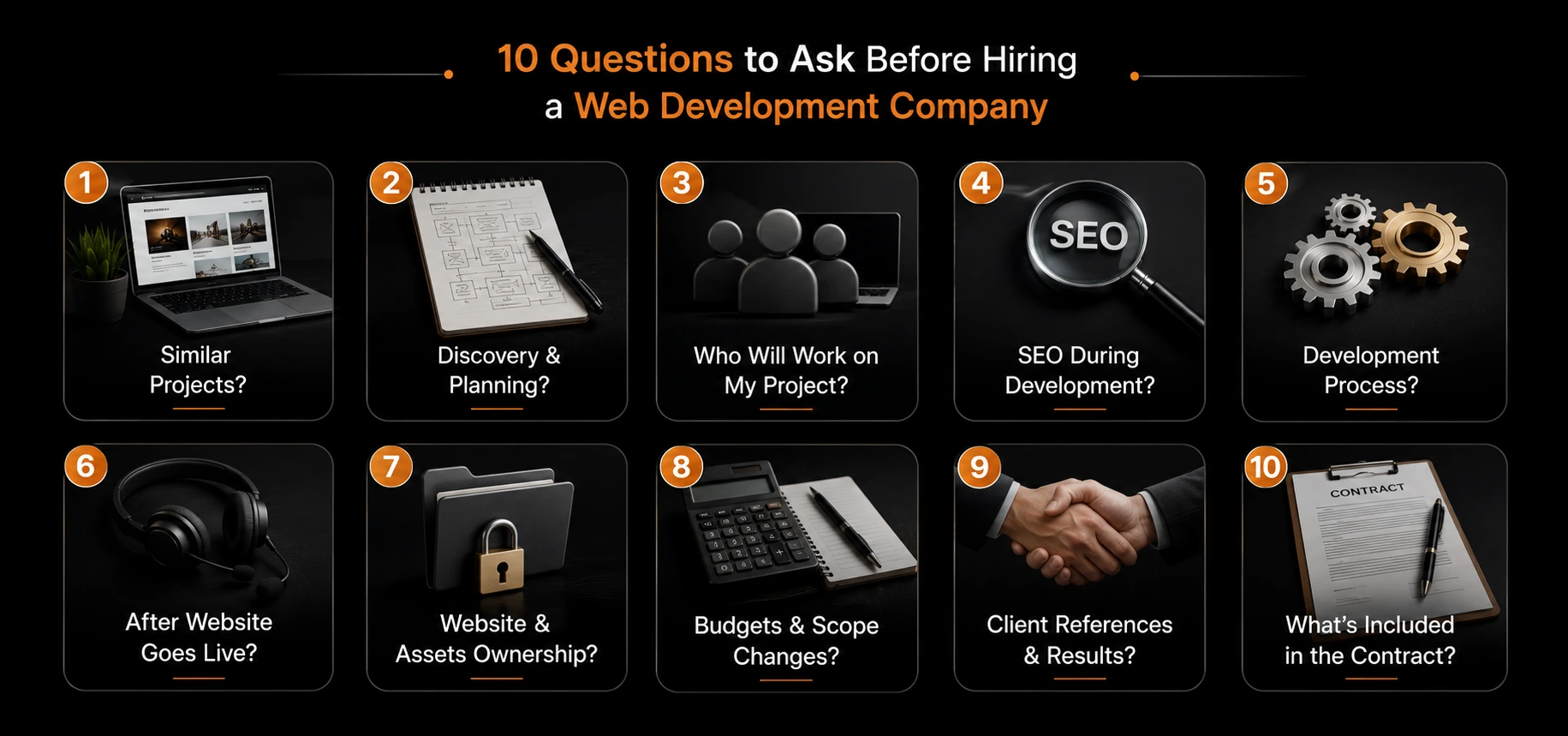
1. Have You Built Websites Similar to Mine?
The first step in learning how to choose a web development company is checking whether the agency has experience with businesses and projects similar to yours. Relevant industry experience helps agencies avoid common problems and recommend more suitable solutions.
For example:
- Online retailers require secure payment processing and reliable inventory integrations.
- Healthcare websites may require stricter privacy, accessibility, and compliance standards.
- SaaS companies often prioritize conversion optimization, product onboarding, and subscription management.
- Enterprise projects often require complex integrations, permissions, and scalable infrastructure.
Instead of asking only how many websites the agency has built, ask about projects that involved challenges similar to yours. Relevant experience reduces project risk and can produce better outcomes.
2. How Do You Handle Discovery and Planning?
Visual design is important, but successful website projects begin with planning and research. When evaluating a web development company, ask how it discovers your business requirements before design or coding begins.
The best agencies start by understanding:
- Business goals and measurable objectives.
- Customer needs, expectations, and pain points.
- Competitive landscape and market positioning.
- User journeys, content structure, and conversion paths.
- Integrations, security needs, and technical specifications.
A structured discovery process creates a clear project roadmap and reduces misunderstandings. It should also include user research and UI/UX design planning before development starts. Skipping discovery is often a sign that the company lacks a strategic process.
3. Who Will Actually Work on My Project?
The people assigned to your website matter more than the agency’s name. Before proceeding, understand who will manage, design, develop, test, and deliver your project.
Ask whether the team includes:
- A project manager responsible for scheduling and communication.
- UI/UX designers responsible for visual design and usability.
- Front-end and back-end developers responsible for functionality.
- QA professionals responsible for quality, compatibility, and performance.
- SEO specialists responsible for technical search visibility.
- Content specialists responsible for clear website messaging.
Understanding the team structure clarifies accountability, communication, and how decisions will be managed throughout the project.
4. How Do You Approach SEO During Development?
SEO should not be treated as a post-launch activity. A strong development process includes technical SEO from the beginning so the website is built for visibility, performance, accessibility, and usability.
Ask whether the agency includes:
- Clean, semantic, and crawlable code.
- Mobile-responsive website development.
- Core Web Vitals optimization.
- Schema markup implementation.
- Page-speed and image optimization.
- Proper heading, title, and content structure.
- Logical navigation and crawl-friendly site architecture.
A visually attractive website may still struggle to generate organic traffic when its technical foundation is weak. For mobile-first experiences, it is also useful to understand how progressive web apps support mobile-first web development.
5. What Does Your Development Process Look Like?
Professional agencies follow a clear workflow instead of making random decisions during development. Ask the agency to explain how it will plan, design, build, test, launch, and maintain your website.
For interactive front-end projects, agencies may recommend technologies such as ReactJS development or Angular web development. For content-driven business websites, PHP web development may be a practical option. For complex server-side features, agencies may rely on Python development or Node.js development to build secure and scalable back-end systems.
Typical development steps include:
- Identifying and analyzing project requirements.
- Defining website goals, users, and success metrics.
- Creating wireframes and user-flow structures.
- Designing the user interface and user experience.
- Developing front-end and back-end features.
- Completing functional, performance, accessibility, and security testing.
- Launching the website and completing deployment.
- Providing post-launch support and maintenance.
A clear workflow improves communication, manages expectations, and reduces confusion throughout the project. Projects with complex data requirements may also need professional database development to support secure and reliable information management.
6. What Happens After the Website Goes Live?
Launching a website is only the beginning. Before hiring an agency, understand what post-launch support it provides and how it will keep your website secure, functional, and updated.
Ask whether ongoing support includes:
- Vulnerability monitoring and security updates.
- Troubleshooting and bug fixing.
- Regular backups and recovery support.
- Performance monitoring and optimization.
- Hosting and server administration.
- Future feature enhancements and content updates.
Modern teams may also use tools covered in this guide to AI tools for web development, but automation should never replace proper maintenance. A reliable maintenance plan should include regular quality assurance checks so updates do not introduce new errors.
7. Who Owns the Website and Its Assets?
Many businesses overlook ownership when commissioning a website. Ensure that your company will have complete control of the website and its digital assets after the project is completed and all contractual terms are met.
Verify ownership of:
- Source code and development files.
- Website design files and creative assets.
- Domain registration details and DNS access.
- Hosting and server account access.
- Website content, images, videos, and media files.
- CMS credentials and administrative access.
Clear ownership terms protect your business and prevent operational problems later. Include these details in your web development contract before work begins.
8. How Do You Manage Budgets and Scope Changes?
Website projects often evolve as new ideas, features, and requirements appear during development. Ask how the agency defines scope changes, approves additional costs, and communicates budget updates.
Agencies using structured DevOps services can often manage deployments, updates, and release processes more efficiently.
Ask about:
- What qualifies as a scope change?
- How are additional costs estimated and approved?
- What happens when specifications change?
- How many revision and feedback rounds are included?
- How are timeline and budget updates communicated?
Transparent companies explain these terms before development begins instead of surprising clients with unexpected invoices later.
9. Can You Share Client References and Results?
A portfolio shows what an agency has created, but client references reveal how the agency works. Ask for case studies or references that demonstrate communication, reliability, problem-solving, and measurable project results.
Ask previous clients about:
- Project transparency and communication quality.
- Timeline and deadline management.
- Flexibility when requirements changed.
- Support provided after launch.
- Business outcomes generated by the project.
Strong agencies are usually comfortable discussing past results and explaining how their work supported a client’s goals.
10. What Will Be Included in the Contract?
Review every part of the agreement before signing. A clear contract protects both parties, prevents misunderstandings, and defines responsibilities throughout the project.
Your contract should clearly define:
- Project scope and deliverables.
- Pricing and payment schedule.
- Project timeline and key milestones.
- Ownership and access rights.
- Revision limits and feedback process.
- Maintenance and post-launch support terms.
- Warranties, termination terms, and cancellation policies.
A complete agreement keeps expectations clear and supports a smoother working relationship from planning through launch.
Practical Website Development Company Selection Criteria
When comparing multiple agencies, use the same evaluation framework for each company instead of relying on price or presentation alone.
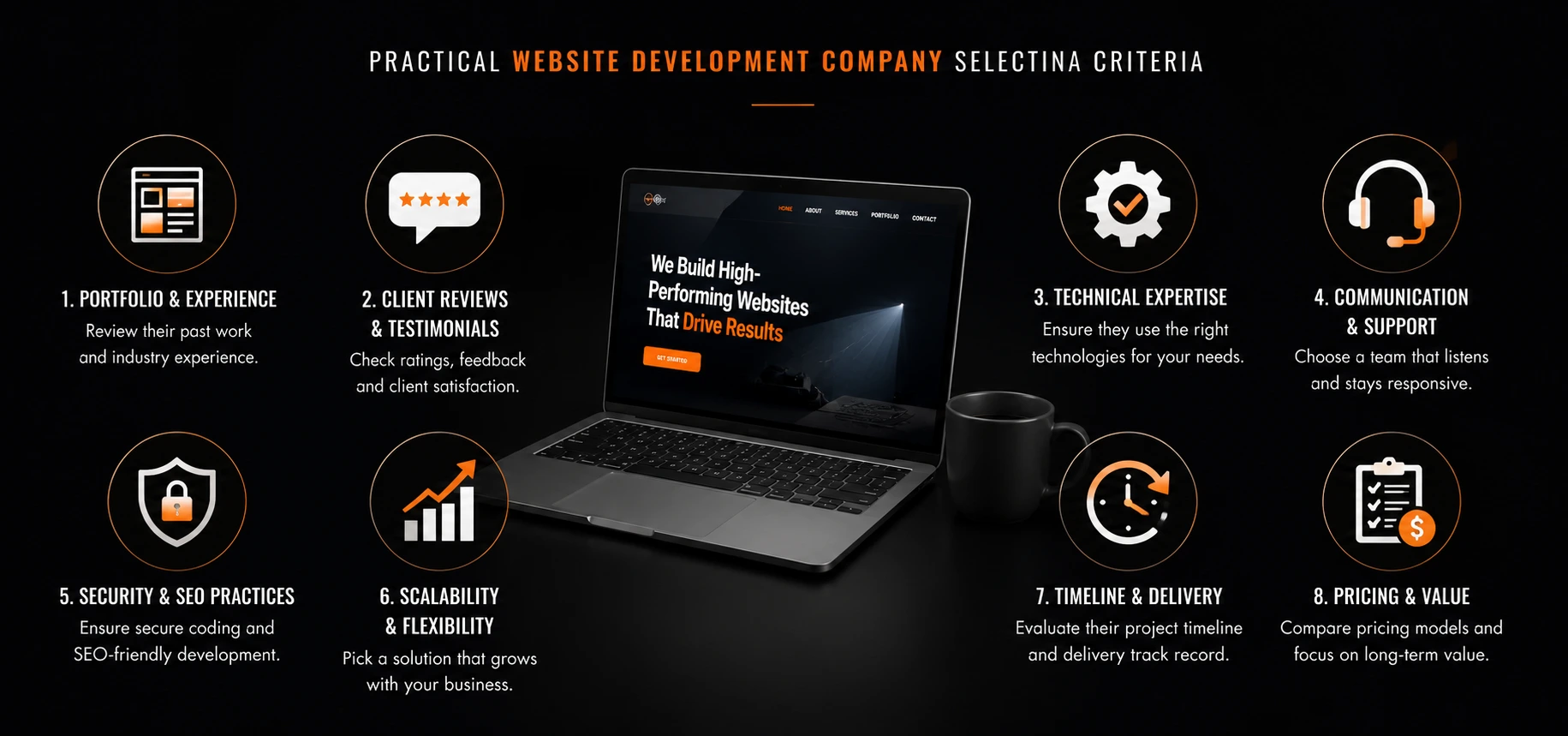
| Criteria |
What to Look For |
| Experience |
Relevant industry projects with measurable outcomes. |
| Communication |
Clear, timely, and transparent responses. |
| Technical Expertise |
Modern technologies and scalable development practices. |
| SEO Knowledge |
Technical SEO integrated into development. |
| Project Management |
Defined timelines, milestones, responsibilities, and reporting. |
| Support |
Reliable maintenance and post-launch services. |
| Transparency |
Honest pricing and clearly defined deliverables. |
| Portfolio |
Real business results, not only attractive designs. |
| Reviews |
Consistent client feedback about reliability and results. |
| Flexibility |
Ability to adapt as business requirements evolve. |
If your business also needs mobile products, choosing a company that offers mobile app development can be an advantage. These selection criteria help you compare agencies objectively.
Common Red Flags You Should Never Ignore
Choosing a development partner involves more than comparing prices and portfolios. Certain warning signs may indicate weak processes, poor communication, or future project problems.
Be cautious of companies that:
- Promise unrealistic delivery times.
- Offer extremely low prices without detailed estimates.
- Avoid discussing timelines, milestones, or responsibilities.
- Cannot clearly explain their development process.
- Have no recent case studies or client references.
- Do not discuss website ownership rights.
- Guarantee first-page Google rankings.
- Provide vague proposals with unclear deliverables.
Asking direct questions helps you understand how honest an agency is about risks, costs, limitations, and client responsibilities.
Should You Choose the Cheapest Agency?
Choosing a web development company based on price alone can become expensive later. Instead of selecting the lowest quote, evaluate the quality, support, scalability, and long-term value the agency can deliver.
| Choosing the Cheapest Agency |
Choosing Based on Value |
| Lower upfront cost. |
Investment focused on long-term ROI. |
| May compromise performance and code quality. |
High-quality development and scalable architecture. |
| Limited security and maintenance. |
Strong security and dependable ongoing support. |
| Basic SEO or no technical optimization. |
Technical SEO included during development. |
| May lead to expensive redesigns later. |
Built for future growth and easier upgrades. |
| Limited communication and support. |
Transparent communication throughout the project. |
| Focuses on completing the project. |
Focuses on achieving business goals. |
The best web development company is not always the cheapest or the most expensive. It is the company that understands your objectives, communicates clearly, and builds a website that continues to support your business after launch.
Build a secure, scalable, and high-performing website with an experienced development team.
Your Final Decision Checklist
Before signing an agreement, review this checklist to confirm that you have covered the most important aspects of the project.
- Does the agency understand your business goals?
- Is the development process clearly explained?
- Have you reviewed relevant projects and real client results?
- Is SEO included from the beginning?
- Do you know who will own the website and its assets?
- Are the timelines realistic?
- Is post-launch support included?
- Is the pricing transparent?
- Are responsibilities clearly documented?
- Would you feel comfortable working with the team for several months?
Reviewing real app portfolio examples can provide additional confidence when the agency may also support connected web and mobile products.
Final Thoughts
When selecting a web development company, look beyond attractive designs and low prices. The best agency will understand your business goals, communicate clearly, follow a structured development process, and provide support well beyond launch.
By asking the right questions before signing a contract, you can choose a partner that offers long-term value and reduces unnecessary risk. Invest in a company that can build a secure, scalable, and effective website that supports your business for years. When you are ready to discuss your requirements, contact us for expert guidance.
Frequently Asked Questions
1. How do I choose a web development company?
Look for an agency with relevant experience, a clear development process, transparent pricing, strong communication, and dependable post-launch support. Choose a partner that understands your business goals.
2. What questions should I ask a web development company?
Ask about its experience, discovery process, assigned team, SEO approach, development workflow, timeline, pricing, ownership terms, and maintenance services.
3. What should a web development contract include?
The contract should cover project scope, deliverables, timeline, pricing, payment terms, ownership rights, revisions, warranties, maintenance, and post-launch support.
4. How do I evaluate a web development company?
Review its portfolio, case studies, client feedback, technical expertise, communication style, project process, and ongoing support capabilities.
5. Should SEO be included during website development?
Yes. Technical SEO, mobile responsiveness, page speed, semantic structure, schema markup, and crawlability should be considered during development.
6. Why is post-launch support important?
Regular maintenance, security updates, backups, monitoring, and bug fixes keep your website secure, fast, and reliable after launch.
7. Who owns the website after it is completed?
Once the project is complete and contractual obligations are met, your business should own the website, source code, content, design assets, and related access credentials unless the agreement states otherwise.
8. How do agencies handle scope changes?
Professional agencies define the scope-change process, approval requirements, additional costs, timeline effects, and revision limits before development begins.
9. Should I choose the cheapest web development company?
Not necessarily. Focus on expertise, communication, scalability, security, support, and long-term value instead of choosing only the lowest-priced option.
10. What makes the best web development company for a business?
The best company understands your goals, communicates clearly, uses suitable technologies, builds scalable websites, and provides reliable long-term support.