How Businesses Can Make Money From Mobile Game Development in 2026
Key Takeaways
- Mobile game development can be highly profitable, but revenue varies significantly based on genre, player retention, monetization, acquisition costs, and market reach.
- Businesses can earn money from mobile games through multiple channels, including in-app purchases, advertising, subscriptions, battle passes, virtual economies, partnerships, and licensing.
- Hybrid monetization allows businesses to serve different player segments with different revenue models while balancing monetization with player experience.
- The best monetization strategy depends on the game genre and player behavior. RPGs may benefit from IAP and battle passes, while casual games can perform well with ads and boosters.
Introduction
The question being widely searched now is whether mobile game development is actually a profitable business in 2026? The answer is yes! However there is no fixed earning figure for it. A mobile game development service generates a modest side income, sustainable revenue product or a scale into a multi-million dollar business.
Genre, player retention, monetization strategy, geographic reach, user acquisition costs, and ongoing LiveOps all have a direct impact on revenue. A game with millions of downloads can still struggle financially if players leave quickly or acquisition costs exceed their lifetime value. However, as per Statista report the revenue to be generated in mobile games is projected to reach US$134.22bn in 2026.
For businesses looking to earn money from a mobile game, development is only the starting point. In this blog post, learn about the real opportunity to generate revenue through mobile game development. Also, explore the common monetization models like in-app purchases, advertising, subscriptions, battle passes, and live content.
How Mobile Game Development Helps Businesses Generate Revenue
Mobile game development can become a long-term revenue channel for businesses when monetization is considered alongside gameplay, retention, and player experience. Instead of depending on a single source of income, companies can build several revenue streams into the same game.
Some of the most common opportunities include:
- In-app purchases: Sell virtual currency, characters, cosmetics, boosters, upgrades, and other digital items.
- In-game advertising: Generate revenue through rewarded videos, interstitials, and other ad formats without requiring every player to make a purchase.
- Subscriptions and battle passes: Create recurring revenue through premium memberships, seasonal reward tracks, and exclusive content.
- Virtual economies: Design currencies and digital goods that encourage ongoing transactions while maintaining a balanced player economy.
- Brand partnerships: Integrate sponsored content, branded events, or promotional experiences into the game.
- Licensing and IP: Extend a game’s characters, assets, or intellectual property into merchandise, media, or other digital products.
- Cross-selling: Use the game to introduce players to related products, services, communities, or digital experiences offered by the business.
Build a Mobile Game Designed for Revenue, Retention & Scale
Mobile Game Monetization Models Businesses Use to Make Money
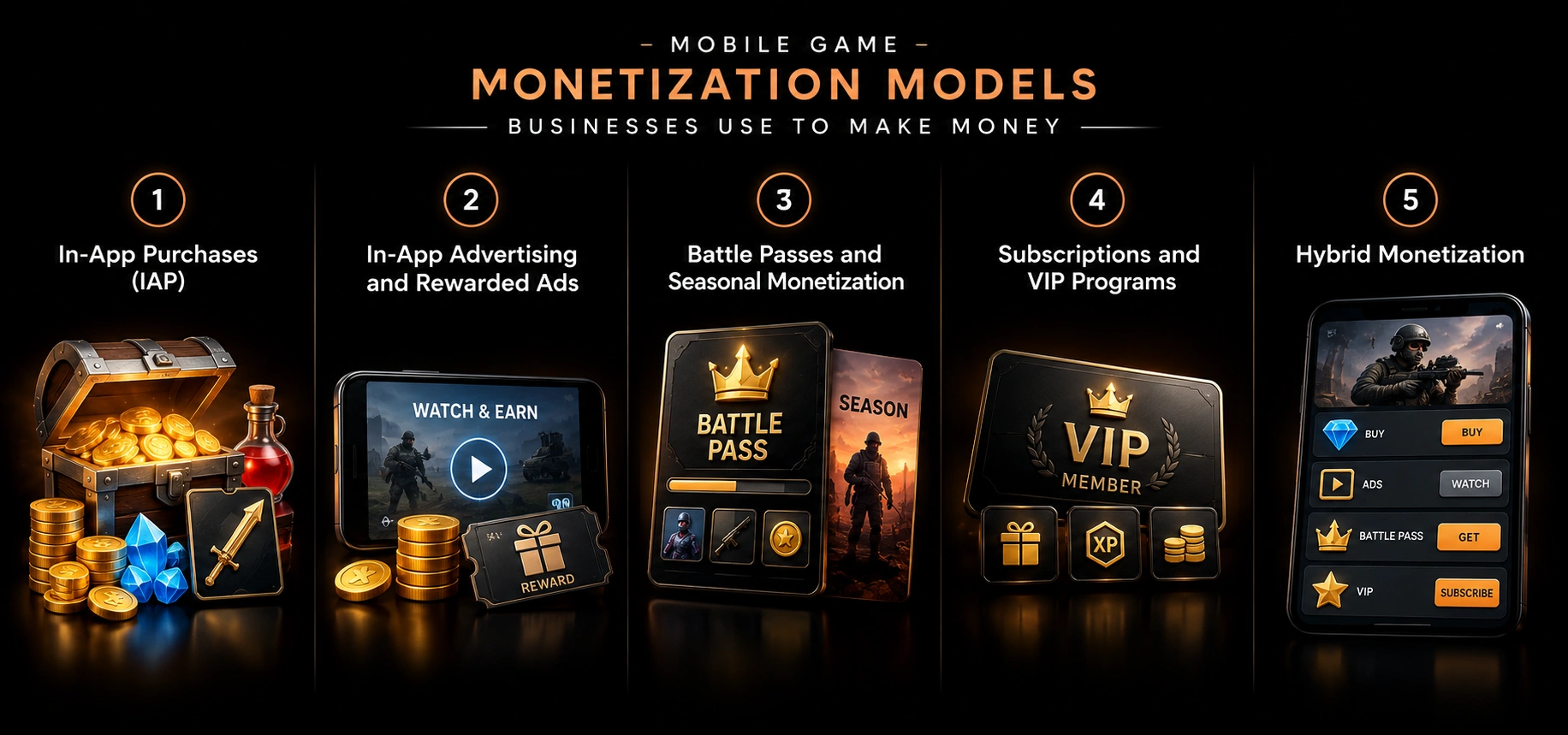
Choosing a monetization model is one of the most important decisions in mobile game development because it directly affects both revenue and player retention. Businesses can monetize through purchases, advertising, recurring memberships, or a combination of these approaches. The right model depends on the game’s genre, audience, session length, progression system, and how frequently players return.
1. In-App Purchases (IAP)
In-app purchases are one of the most direct ways for businesses to earn money from a mobile game. Players can purchase virtual currency, 2D characters, cosmetics, power-ups, progression items, or limited-time bundles. This model works especially well for RPG, strategy, simulation, and multiplayer games where players have long-term progression goals. A well-designed IAP system gives players optional ways to enhance their experience without making basic gameplay feel restricted.
Key factors:
- Virtual currency and economy balancing
- Product pricing and SKU management
- Secure server-side purchase validation
- Player segmentation
- Purchase and conversion analytics
2. In-App Advertising and Rewarded Ads
In-game advertising allows businesses to monetize players who do not make purchases. Rewarded videos are particularly effective because players choose to watch an ad in exchange for benefits such as extra lives, bonus currency, or additional gameplay attempts. Interstitials, banners, and playable ads can also contribute to revenue when placed appropriately. The challenge is maintaining a balance between ad frequency and player experience. Too many interruptions can increase churn and reduce the game’s long-term revenue potential.
Key factors:
- Rewarded video placement
- Ad mediation
- Frequency caps
- Reward validation
- eCPM and impression tracking
3. Battle Passes and Seasonal Monetization
Battle passes convert regular gameplay into recurring revenue opportunities. Players typically receive a free progression track, while a premium track provides additional rewards such as cosmetics, currency, 3D characters, or exclusive content. New seasons encourage players to return regularly and give businesses opportunities to sell premium passes repeatedly. This model is particularly effective for multiplayer, RPG, strategy, and live-service games with frequent content updates.
Key factors:
- Free and premium reward tracks
- Seasonal challenges
- Progression milestones
- Limited-time content
- LiveOps and automated reward systems
4. Subscriptions and VIP Programs
Subscriptions provide recurring revenue by offering players benefits over a monthly or annual period. Depending on the game, these benefits can include ad-free gameplay, daily rewards, premium currency, exclusive items, faster progression, or VIP status. This model works best when players regularly return to the game and perceive continuous value from their membership. Businesses should focus on benefits that complement gameplay rather than restricting essential features behind a subscription.
Key factors:
- Monthly or annual plans
- Exclusive rewards
- Premium currency
- Ad-free experiences
- VIP benefits and loyalty rewards
5. Hybrid Monetization
Hybrid monetization combines multiple revenue streams, typically including IAP, advertising, battle passes, or subscriptions. This approach allows businesses to monetize different player segments according to their behavior. For example, non-paying players can generate advertising revenue, occasional spenders can purchase low-priced items, while highly engaged users can subscribe or buy premium passes. The goal is not to add every possible monetization method, but to create a balanced system that supports both revenue and retention.
A typical approach:
- Non-spenders: Rewarded ads
- Occasional spenders: Small IAP
- Regular spenders: Bundles and cosmetics
- Engaged players: Battle passes
- Loyal players: Subscriptions/VIP
Choosing the Right Mobile Game Monetization Strategy by Genre
There is no single monetization model that works equally well for every mobile game. The right approach depends on how players interact with the game, how long sessions typically last, and whether the game has progression, competition, or social elements. Short-session games often rely more heavily on advertising, while games with deeper progression can generate stronger IAP and recurring revenue.
| Game Type |
Primary Monetization |
Secondary Monetization |
Why It Works |
| Hyper-casual |
Ads |
Remove-ads IAP |
Frequent, short sessions create more opportunities for ad impressions. |
| Casual Puzzle |
Ads + IAP |
Boosters |
Players can watch ads for rewards or purchase items to progress faster. |
| RPG |
IAP |
Battle Pass |
Long-term character progression supports virtual goods and recurring purchases. |
| Strategy |
IAP |
Events + Subscriptions |
Competitive progression encourages spending on resources, upgrades, and exclusive content. |
| Multiplayer |
Battle Pass + IAP |
Cosmetics |
Players can spend on seasonal content, customization, and status-driven items. |
| Simulation |
IAP |
Ads + Subscriptions |
Ongoing progression creates opportunities for purchases, while ads can monetize non-spenders. |
What Does It Cost to Build a Revenue-Generating Mobile Game?
The cost of mobile game development depends on more than gameplay and graphics. A revenue-generating game also needs payment infrastructure, analytics, advertising integrations, backend services, security, QA, LiveOps, post-launch optimization and quality assurance services.
For a commercially viable casual-to-mid-core mobile game, businesses can typically plan for around $50,000 to $150,000 in initial development, while more complex multiplayer, RPG, and live-service games can cost $300,000 or significantly more.
A typical budget is influenced by these cost drivers:
| Cost Driver |
Approx. Share of Development Budget |
| Game development & programming |
30–40% |
| Art, 3D animation & UI/UX Design |
20–25% |
| Backend & cloud infrastructure |
8–12% |
| Monetization & payment integration |
3–6% |
| Analytics & player tracking |
3–5% |
| QA & device testing |
7–10% |
| Security & compliance |
2–4% |
| LiveOps preparation |
5–8% |
| Project management & deployment |
5–8% |
Planning a Mobile Game With a Revenue Model in Mind?
How to Improve Mobile Game Revenue After Launch
Launching a mobile game is only the beginning of its revenue journey. Businesses need to continuously monitor player behavior and optimize the experience based on real usage data. Successful games operate as live digital products, with regular updates, events, experiments, and monetization improvements.
Key areas to monitor include:
- A/B testing: Compare prices, offers, and store layouts.
- Offer timing: Present purchases when players are most likely to convert.
- Ad frequency: Balance ad revenue with player retention.
- Onboarding: Reduce early drop-offs and improve activation.
- Player segmentation: Personalize offers based on behavior.
- LTV cohorts: Identify which players generate long-term value.
- Churn analysis: Understand why players leave and address friction points.
- Event performance: Measure engagement and revenue from LiveOps events.
Is Mobile Game Development Still Profitable in 2026?
Yes, mobile game development can still be profitable in 2026, but a growing market does not guarantee that every game will make money. However, market size doesn’t define individual game profitability. Revenue depends on how efficiently a business manages development, user acquisition, retention, monetization, content production, infrastructure, and ongoing operating costs.
The strongest opportunities are therefore not simply games that attract large download numbers. They are games built around strong retention, well-designed monetization, efficient acquisition, and scalable LiveOps that can continue generating revenue long after launch.
How a Mobile Game Development Company Can Increase Game Revenue
A professional mobile game development company can contribute to revenue growth long after the core gameplay is built. The focus should be on creating a measurable product where player behavior can guide monetization, retention, and content decisions. ChicMic Studios services improves gaming industry scenarios by providing game development across iOS and Android and supports features such as in-app purchases, ad modules, multiplayer backends, and game optimization.
A professional mobile game development company can improve monetization through:
- Player analytics
- Retention optimization
- Economy design
- A/B testing
- Personalized offers
- Ad mediation
- IAP implementation
- LiveOps
- Performance optimization
- Cross-platform development
Frequently Asked Questions
1. How much money can you make from mobile game development in 2026?
The earning potential of mobile game development varies from a few hundred dollars to millions. Revenue depends on game genre, retention, monetization, downloads, and market reach. Businesses can earn money from mobile game projects by combining strong gameplay with effective IAP, advertising, subscriptions, and LiveOps.
2. What is the most profitable mobile game monetization model?
There is no single best monetization model. IAP works well for RPGs and strategy games, while advertising suits many casual titles. A mobile game development company can combine IAP, ads, battle passes, and subscriptions to create a hybrid monetization strategy based on player behavior.
3. Can I earn money from a free mobile game?
Yes. Businesses can earn money from mobile game products through in-app purchases, rewarded ads, subscriptions, battle passes, and virtual goods. Free-to-play models can attract a wider audience while creating multiple revenue opportunities. Effective mobile game development services focus on monetizing players without negatively affecting gameplay or retention.
4. How long does it take for a mobile game to become profitable?
Profitability depends on development investment, acquisition costs, retention, monetization, and player LTV. During mobile game development, businesses should track CPI, LTV, conversion rate, and retention to understand when revenue can recover development and marketing expenses.
5. Should a startup hire a mobile game development company?
A mobile game development company can help startups access specialized development, backend, monetization, QA, analytics, multiplayer, and LiveOps expertise. Professional mobile game development services can also reduce development time and provide the technical foundation needed to launch, scale, and continuously improve a commercial game.
6. What are the most important mobile game revenue metrics?
Important metrics for mobile game development include LTV, ARPDAU, ARPPU, retention, conversion rate, CPI, and ROAS. These metrics show how much players are worth, how effectively the game retains and monetizes users, and whether acquisition spending is generating a positive return.
Turn Your Mobile Game Idea Into a Revenue-Generating Product