AI Fitness Agents: How Apps Are Becoming Personal Trainers
Key Takeaways
- AI fitness agents transform traditional fitness apps into intelligent personal trainers that adapt workouts based on real-time user data.
- Wearables, machine learning, computer vision, and reinforcement learning work together to deliver highly personalized fitness experiences.
- AI-powered coaching offers 24/7 availability, real-time form correction, recovery predictions, and adaptive workout planning.
- Compared to human trainers, AI excels in scalability, affordability, and data-driven decision-making while human coaches provide emotional support and motivation.
- Fitness businesses can improve retention, reduce operational costs, and unlock new revenue opportunities through AI-driven personalization.
- Future AI fitness apps will leverage genomic data, AR-based coaching, digital twins, and multimodal wearable technologies for even deeper personalization and engagement.
1. What Are AI Fitness Agents
AI fitness agents are what make adaptive fitness apps possible. They turn tracking tools that are inactive into coaches that are active. These agents use AI workout personalization systems to make sure that every rep, set, and rest time is perfect for the user’s body and progress. This is different from simple apps that give out generic workouts.
At their core, AI fitness agents work with all kinds of devices without any problems. They do this by collecting data from wearable tech and apps to make a full picture of the user. In addition to calorie counts, they look at happiness, sleep quality, and even things like weather or gym crowding. For product leaders, this means making apps that change with users and keep them by smartly engaging them. For startups planning to launch similar intelligent wellness products, working with an experienced fitness app development company can help turn AI coaching, workout tracking, and user engagement features into a scalable product.
Early adopters like Zing Coach and Rayfit show how these agents can be used to mimic one-on-one sessions and make elite training available to a lot of people. As wearable tech for AI coaching becomes more common, bots will be able to handle everything with precision, from warm-ups to cool-downs.
2. How AI Fitness Agents Work
AI exercise agents use a complex, never-ending feedback loop that makes them make decisions like a professional coach. The first step is to enter data. This includes streams from AI coaching using wearable tech like the Apple Watch heart rate variability (HRV), the Oura Ring sleep stages, and Garmin GPS pace data, as well as manual logs for things like diet or mood and location information like temperature or gym noise from phone sensors.
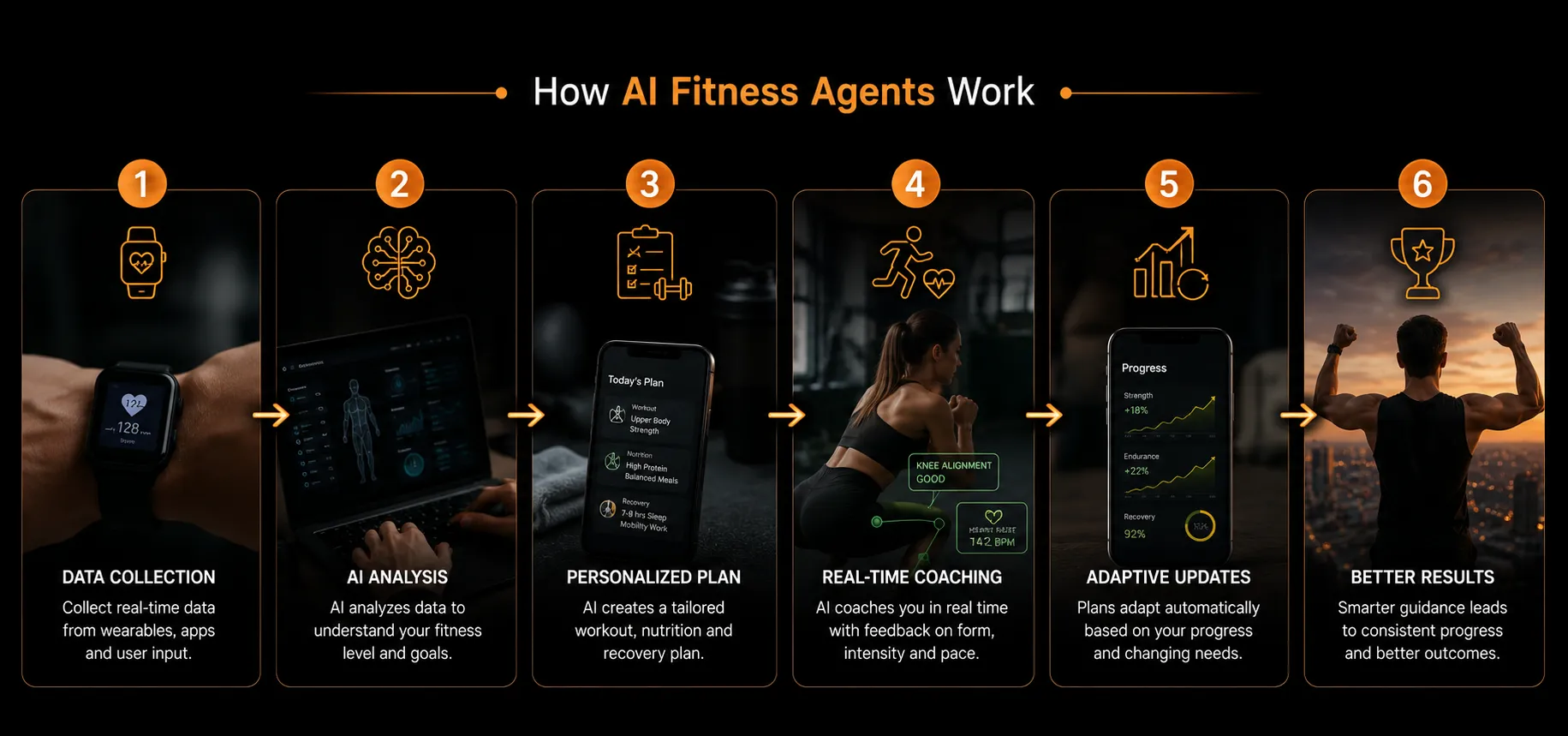
The raw data is then processed by AI. Predictive models like LSTMs figure out how likely it is that a person will get tired, reinforcement learning (RL) finds the best workout parameters by rewarding actions that make people more likely to stick with them, and computer vision checks smartphone camera feeds for biomechanical errors, like knee valgus in squats, with very little delay. This is where strong AI development services become important, as fitness agents need reliable model training, real-time decision-making, and continuous optimization to deliver accurate coaching.
Adaptive fitness apps that use AI to offer personalized workouts (“Extend your plank by 15 seconds”), real-time cues (“Breathe deeper—HR spiking”), and easy-to-use dashboards that show progress trends are the results. RL algorithms change strategies based on results, like higher completion rates from gamified breaks. This means that the agent gets better over time. The age of AI-powered personal fitness coaches is powered by this closed-loop architecture that makes sure accuracy from beginners to experts.
3. Key Features of AI Fitness Apps
AI-powered fitness apps have cutting-edge features that make the user experience better by giving them highly personalized exercise coaching based on data. With these features, AI integration architecture gives users personalized workouts, real-time feedback, and predictions about when they will heal. This makes sure that users have the best and most interesting fitness journey possible. Here are the main things that make AI exercise apps unique:
- Automatic Generation of Workouts:
- AI workout personalization systems change users’ workout plans instantly based on their success and health.
- For example, if HRV trends show that the back is hurting, the system can switch out deadlifts for other exercises that are easier on the body to help with healing.
- Form correction in real time:
- computer vision to give immediate feedback on how to do an exercise.
- In controlled studies, putting AR guides on top of exercises, like “Rotate hips forward” during lunges, improves the efficiency of the exercise by 92%.
- Scores for Predicting Recovery:
- This feature predicts the risks of overtraining using AI-based health monitoring tools.
- Based on information like energy logs, steps taken, and sleep patterns, the system may offer ways to recover, such as “Delay HIIT; opt for mobility,” to keep you from getting hurt.
- Stimulating Behaviors:
- In real time, AI exercise coaches send motivational voice or chat messages, such as “You’re 80% to your PB—push for one more!”
- These nudges are meant to keep users interested and inspired as they work toward their fitness goals.
- AI Systems for Keeping People Fit:
- These systems use behavior-based features, like streak guards and micro-sessions, to keep users coming back.
- Studies show that these methods increase 90-day retention by 35–50% by encouraging users to stick with it, even when they’re having a bad day.
- Mobile Experiences Built on AI:
- Edge machine learning frameworks like TensorFlow Lite are combined with seamless sensor APIs by developers to enable fast processing on both iOS and Android devices.
- This makes sure that performance is always accurate, even when working out or doing other things at the same time.
To deliver these features smoothly across devices, businesses often need expert mobile app development support for sensor integration, real-time dashboards, subscription flows, and app performance optimization.
4. AI Personal Trainer vs Human Trainer
When evaluating AI powered personal fitness coach systems against traditional trainers, the trade-offs become clear: AI delivers unmatched scale and precision, while humans provide irreplaceable intuition. This comparison equips founders and investors to design hybrid models that leverage both. Data from recent deployments shows AI driving 2.5x faster user onboarding, but retention hinges on blending strengths.
AI Personal Trainer vs Human Trainer: A Detailed Comparison
| Feature |
AI Personal Trainer |
Human Trainer |
| Cost |
$10-30/month; zero marginal cost per user |
$50-200/session; scales linearly with time |
| Scalability |
Serves millions simultaneously, no fatigue |
Limited to 20-40 clients/week per trainer |
| Real-Time Data Integration |
Fuses live wearables, biometrics; sub-second adjustments |
Relies on self-reports, post-session reviews |
| Emotional Intelligence & Empathy |
NLP sentiment analysis; scripted motivation |
Reads nonverbal cues, builds deep rapport |
| Exercise Form Correction |
Computer vision (95% accuracy); instant AR overlays |
Hands-on cues; subjective but adaptable |
| Hyper-Personalisation |
Processes 10K+ data points/session for daily tweaks |
Intuitive, experience-based; limited by memory |
| Availability |
24/7 on-demand, global time zones |
Scheduled sessions; off-hours unavailable |
| Accountability |
Automated streaks, nudges; gamified progress tracking |
Personal check-ins; motivational pressure |
AI dominates in efficiency metrics, reducing gym no-shows by 45%, but humans foster long-term mindset shifts through empathy. The winning strategy? AI-handled volume with human oversight for high-risk cases like injury rehab.
5. AI in Fitness Apps: Core Technologies
AI fitness apps rely on layered machine learning models for dynamic, real-time adaptation. Key technologies include:
- Supervised and Reinforcement Learning: In supervised learning, you build basic user profiles, and reinforcement learning adjusts plans by rewarding obedience, as in AlphaGo’s policy networks.
- Deep Learning: LSTMs can take time-series data and predict when someone will get tired. Computer vision programs like MediaPipe Pose can look at joint angles during a movement like a deadlift and detect imbalances.
- Conversational Coaching: Wearables use lightweight inference to minimize latency, allowing devices like the wrist, to count reps in real-time without connecting to the cloud.
- Edge AI on Wearables: Wearables run lightweight inference to reduce latency, allowing real-time rep counting on devices like the wrist, without cloud dependency. Since AI fitness apps rely heavily on connected wearables, IoT app development plays a key role in syncing biometric data, device signals, and real-time health insights.
- Data Fusion: A prediction analysis is performed on a fused embedding of IMU, GPS and HR data. This improves accuracy and effectiveness of workouts.
- Federated Learning: Developed by Google AI researchers to safeguard privacy, this method trains models across devices without viewing raw data. This is in accordance with HIPAA regulations.
These technologies create a powerful foundation for the future of multi-modal, AI-driven fitness apps. Many of these capabilities depend on advanced machine learning development models that can analyze user behavior, predict fatigue, personalize routines, and improve recommendations over time.
6. Benefits of AI Fitness Agents
People who use AI fitness agents and people who run fitness centers and businesses can all gain in many ways. AI’s ability to personalize, scale, and analyze real-time performance data is used by exercise apps to help users keep getting better, save money, and become more involved. Here are some of the best things about AI fitness agents:
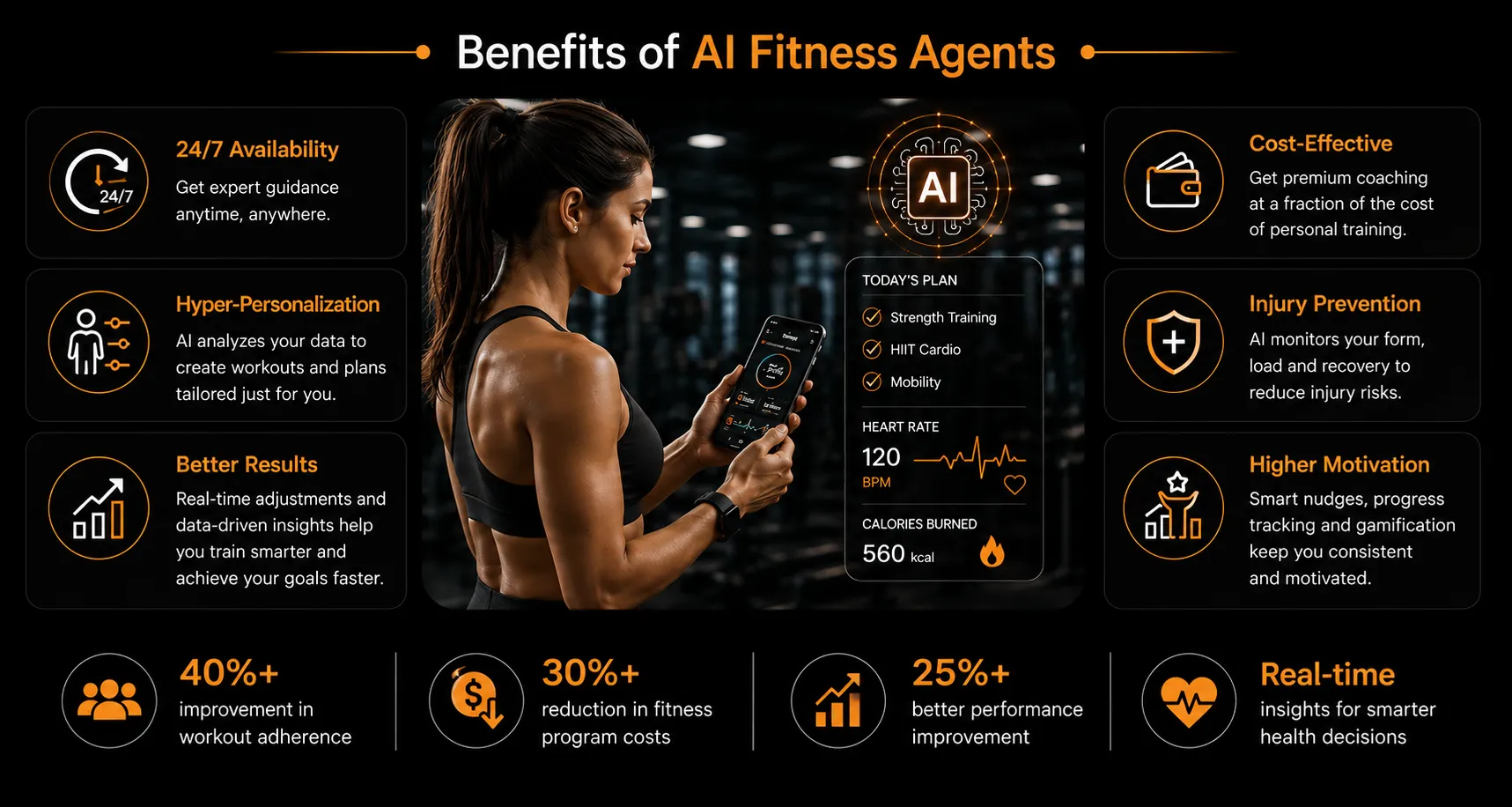
- Personalization that never stops:
- AI-powered adaptive exercise apps change daily plans based on new metrics, such as stress levels and lack of sleep.
- Traditional, static workout programs don’t work as well as this dynamic method, which makes strength and endurance gains 25–35% faster.
- Ability to grow:
- AI agents can help thousands of users at once without getting tired, which means that exercise apps can grow without having to pay more to run.
- AI exercise agents cut gym and studio costs by 70% by cutting down on the need for physical trainers. They also made fitness more accessible to people and places that don’t have enough of it.
- Recovery Insights Based on Data:
- Agents can accurately predict overtraining windows 85% of the time by using AI to track and analyze fitness. This helps users avoid injuries and reach their full performance potential.
- Based on real-time data, these tips help users make their fitness routines better, which speeds up recovery and makes training more effective.
- Feedback without bias:
- AI agents give objective, data-driven cues based on biomechanics. This gets rid of the bias that can happen with human teachers.
- This makes sure that all users, no matter who they are or how engaged they are, get the same fair feedback during their workouts.
- Better retention with behavioral nudges:
- AI fitness retention systems keep users interested by using streak protections and nudges based on behavior.
- These systems have been shown to increase 90-day retention by 40–60% by encouraging micro-habits and social challenges. This makes people more likely to stick with their exercise goals for a long time.
- Making money and growing:
- These features mean that fitness businesses make more money per user (ARPU) and that their apps spread more quickly, which makes AI fitness apps a strong way to get new customers and keep old ones.
- As fitness apps get better, they bring in more premium subscriptions and new business possibilities, which makes for a stable way to make money.
AI fitness bots not only help users make faster progress and get better coaching, but they also give fitness businesses the ability to grow and keep customers interested for long-term success.
7. Real-World Use Cases of AI Fitness Apps
Actual deployments show how AI improves fitness apps across sectors:
- Performance and Injury Prevention
WHOOP’s Strain and Recovery Loop: AI-based health monitoring systems reduce injuries by 20% by adjusting training loads. It optimizes recovery and performance for athletes. Similar AI-driven monitoring is also reshaping digital health, where healthcare app development helps businesses build secure, compliant, and data-rich wellness platforms.
- Bodyweight Training Customized
Freeletics’ Adaptive Coaching Engine: AI tailors bodyweight circuits to user feedback, increasing workout completion by 50%. It improves workouts by adapting to user progress.
- Fitness Class Customization and Subscriber Growth
Peloton’s Personalization Layer: AI designs classes based on ride data, increasing user engagement and pleasure to 6 million+ subscribers.
- AI Weightlifting Plans
Fitbod’s Algorithmic Programming: AI improves muscle growth for 1 million+ users by creating individualized weightlifting routines based on equipment scans and user progress.
8. Challenges in AI Fitness Systems
While AI fitness systems offer immense potential, they face key challenges:
- Data Privacy: HIPAA/GDPR-compliant encryption and federated learning secure user data in AI fitness apps that stream biometrics. For deeper context on AI adoption in regulated health environments, you can also explore how AI is transforming healthcare beyond the hype.
- Algorithmic Bias: Limited-data models may underperform women and elderly, result in inappropriate fitness plans. Multiple datasets can reduce bias.
- Sensor Accuracy: Poor sensor accuracy in cheap wearables can affect data quality. Excellent sensors are essential for accurate tracking.
- Over-Reliance on AI: Users may overlook body awareness. AI support and self-awareness must balance.
- User Trust: AI decision-making without transparency can damage trust. Engaging users requires explainable AI.
- Cold-Start Problem: Generic plans may cause early churn. Further data collection during onboarding helps.
- Regulatory Compliance: The FDA governs AI features like cardiac forecasts, and as the WHO’s physical activity guidelines increasingly mention digital health aids, regulatory convergence is imminent.
9. How to Build AI Fitness Apps
Strategic thinking about data, design and model selection are key to building AI fitness apps.
- Data Strategy: First, classify stance landmarks and fatigue indicators in separate data sets for workout videos, biometrics and user feedback.
- Model selection: MediaPipe collaborative filtering for exercise personalization Pose estimation for real-time fitness coaching Reinforcement learning for real-time fitness coaching
- Scalable Architecture: Training and running on cloud/edge infrastructure like AWS SageMaker and TensorFlow Lite. Wearable devices are connected to HealthKit and Google Fit SDKs to process data in real time. If the app includes conversational coaching, personalized recommendations, or AI-generated workout explanations, custom LLM development can help create a more natural and intelligent coaching experience.
- Federated Learning: If you care about data privacy when training across user devices, build in federated learning from day one.
- Monetization & Testing: Tiered APIs for monetisation; freemium for consumers, white label for gyms. Explainability improvements, retention A/B test with 1K beta users Budget $100K-500K for MVP development.
Prototypes become category leaders by delivering personalized fitness experiences while ensuring scalability and data compliance.
10. Future of AI Fitness Agents
Fitness app AI advances blur applications and human coaches Hyper-personalized genomic fitness sequences DNA for muscle fiber optimization and prescribes fast/slow-twitch dominance.
Early trials indicate 40% efficiency gains.
AI coaches that are emotionally intelligent use advanced NLP and sentiment models to recognize when someone is becoming displeased and then respond using humor or mindset changes. Biomechanical digital twins put your virtual body through its paces in silicon before you sweat.
Fully multi-modal wearable AI utilizes AR glass overlays, haptics for rhythm cues and neural interfaces to read intent – think “squat” and it will guide you through reps. Semi-autonomous health agents handle physio for imbalances and nutrition API syncs. Apple’s developer documentation on sensor frameworks reveals how raw IMU data will power next-gen coaching models. Fitness AI pioneers envision next-gen personalized digital health, seamless longevity stack bridges and re-framing wellness as predictive orchestration. As AR-based coaching becomes more common, AR app development can help fitness brands create immersive workout guidance, posture overlays, and interactive training experiences.
Frequently Asked Questions
1. What are AI fitness agents?
App-based AI trainers offer custom workouts and feedback using real-time data.
2. How do AI fitness applications work?
Collect biometrics/wearable data, use ML to analyze, build adaptive plans, update with user feedback.
3. Can personal trainers be replaced by AI agents?
AI brings data-driven precision; people bring empathy and intuition. Hybrids have the best of both.
4. What are the advantages of an AI fitness app?
24/7 access, hyper-personalization, 40%+ adherence improvements, cost savings and predictive injury avoidance.
5. Are AI fitness apps accurate?
90-97% form detection and predictions with good data; multi-modal AI gets better.
6. What is the future of fitness AI agents?
By 2030: genomic personalization, AR haptics, digital twins, ecosystem agents.
7. What data do AI fitness apps collect?
HR, sleep, GPS, reps, mood, food locally fused with opt-in cloud sync.
8. How AI fitness agents boost user retention?
Predictive nudges, streaks and gamification increase 90-day rates 35-50%.
9. AI fitness coaches: Is my health data safe?
Yes – federated learning, end-to-end encryption, GDPR/HIPAA compliance.
10. How much does it cost to develop an AI fitness app?
The cost of developing an AI fitness app depends on features such as wearable integration, computer vision, AI coaching, personalized workout plans, and analytics dashboards. A basic solution may start at $20,000-$50,000, while advanced AI-powered fitness platforms can exceed $100,000 in development costs.
Build the Next Generation of AI Fitness Agents
ChicMic Studios is giving health-tech startups, engineers and investors the insight to lead this revolution. Check out our deep dives into multimodal AI Development, exclusive chats with Zing Coach architects, and trend studies predicting 2030 breakpoints. Subscribe for weekly insights and join the discussion below. Connect with others building scalable agents. We’ll shape the intelligent future of fitness together.