How to Start Your Own MMORPG Game Development Project in 2026
Key Takeaways
- Start with an MVP and validate the core gameplay loop before expanding the MMORPG world.
- Build for scalability by planning server architecture, networking, databases, and security from the beginning.
- Budget depends on factors like account for development, content, infrastructure, testing, and ongoing LiveOps costs.
- Partnering with a company like ChicMic Studios provides continuous updates, monitoring, balancing, and player feedback are essential for long-term MMORPG success.
Introduction
In 2026, building MMORPG requires more than creating a 3D world with multiplayer features. MMORPG game development combines game design, real-time networking, persistent databases, backend services, content production and long-term LiveOps.
The ideal approach followed by the right game development company is to define the game concept, validate gameplay loop, establish multiplayer architecture and build MVP before expansion. The MMORPG game world also needs infrastructure that maintains player progression, inventory, social relationships, economy, and world state across sessions.
This guide explains how to approach MMORPG development in 2026, including the technology stack, development process, infrastructure, testing requirements, and factors that influence MMORPG game development cost.
What Makes MMORPG Game Development Different in 2026?
An MMORPG is fundamentally a persistent online system as well as a game. Players share a logical world, retain their characters and progression between sessions, interact with other players, and participate in economies and social systems.
Unlike a conventional multiplayer game that may create a temporary match and discard its state afterward, an MMORPG must continuously manage persistent data and real-time interactions.
The major technical requirements include:
- Persistent characters, inventory, skills, and progression
- Dedicated or distributed game servers
- Real-time player synchronization
- Account and authentication services
- Guilds, parties, chat, and trading
- PvE and PvP systems
- Persistent economy and item databases
- Anti-cheat and security mechanisms
- Analytics and monitoring
- Continuous content updates and LiveOps
This makes MMORPG development closer to building a distributed software platform with a game client than simply adding multiplayer functionality to an existing game.
MMORPG vs. Standard Multiplayer Game Development
The persistent shared world is the defining characteristic. This distinction should be established during pre-production because it affects almost every subsequent technical decision.
| Persistent shared world |
Usually session-based |
| Large concurrent populations |
Usually smaller player groups |
| Guilds, trading and social systems |
Optional social features |
Define Your MMORPG Concept, Core Loop, and Target Players
Before choosing an engine or assembling a development team, define what players will actually do in the world.
Start by documenting the game’s genre, setting, progression model, target audience, platform, monetization approach, and expected player population.
1. Define the MMORPG Genre and World
Decide whether the project is:
- Fantasy game
- Sci-fi game
- Sandbox game
- Action game
- Survival game
- Strategy game
- Social or community-focused
The genre determines the technical, content and development cost requirements. For example, a territory-control sandbox may need a sophisticated player-driven economy, while a theme-park MMORPG may require a much larger quest and dungeon pipeline.
2. Define the Core Gameplay Loop
Every major system should reinforce a clear loop. If the core gameplay isn’t enjoyable with a small number of players, expanding the world will not solve the underlying problem.
3. Establish an MMORPG MVP
Do not start by building the complete game world.
A practical MMORPG MVP could contain:
- One playable zone
- One or two character classes
- Core combat
- Basic enemies and NPCs
- Character progression
- Inventory
- Multiplayer synchronization
- Account persistence
- Basic social features
The purpose of an MVP is to prove that the core gameplay and technical architecture work before significant resources are committed to large-scale content production.
Plan the Technical Architecture for MMORPG Game Development
Technical architecture should be established before full production because changing the underlying networking or persistence model later can require significant redevelopment.
1. Choose a Server-Authoritative Architecture
Important game-state decisions should be validated on the server rather than trusted entirely to the client.
The server should control or validate:
- Character movement
- Combat results
- Damage calculations
- Inventory changes
- Currency transactions
- Item ownership
- Progression
- Important world-state changes
This reduces opportunities for client manipulation and provides a consistent source of truth for connected players.
2. Design World and Zone Servers for Scalability
MMORPG worlds commonly use sharded, zone-based, or single-shard architectures. Sharding creates multiple copies of a world, while zone-based architecture distributes different areas across server processes. Single-shard architectures attempt to maintain one logical universe but require significantly more sophisticated infrastructure.
For a new project, the architecture should be selected according to the expected concurrency rather than an aspirational player count.
A smaller MMORPG may be better served by a sharded or zone-based architecture that can scale incrementally.
3. Implement Interest Management
A server does not need to send every player’s state to every connected client. Interest management, also known as Area of Interest (AoI), determines which entities are relevant to a specific player. For example, a client may receive updates for nearby players, NPCs, projectiles, and objects while ignoring entities several kilometers away.
This reduces network traffic and server processing requirements. It becomes especially important when many players occupy the same region.
Plan a Scalable Backend for Your Persistent Game World
Choose the Right MMORPG Game Development Technology Stack
Before selecting the technology stack for every MMORPG. Engine selection should depend on the target platform, visual requirements, combat model, expected concurrency, team expertise, and backend architecture.
1. Select the Game Engine
Unity can be appropriate for cross-platform MMORPGs, including projects targeting PC, mobile, and other platforms. It also provides access to a large ecosystem of networking and multiplayer technologies.
Unreal Engine is well suited to visually intensive 3D games and provides dedicated-server and replication capabilities that can support complex multiplayer gameplay.
ChicMic Studios Unity game development services cover 2D, 3D, multiplayer, and backend development, while its Unreal game development capabilities cover projects across multiple platforms.
2. Build the Backend and Server Infrastructure
A typical MMORPG backend may include:
- Authentication and account management
- World or zone servers
- Instance servers
- Matchmaking
- Chat and social services
- Player persistence
- Database development systems
- Caching
- Analytics and telemetry
- Content delivery
- Monitoring and logging
Potential technologies can include C#, C++, Node.js, Go, Python, PostgreSQL, SQL/NoSQL databases, Redis, dedicated servers, cloud infrastructure, and CI/CD pipelines.
The exact combination should be determined by system requirements rather than by selecting technologies simply because they are popular.
3. Plan Cloud Infrastructure and DevOps
MMORPG infrastructure must handle unpredictable traffic. Cloud architecture can provide tools for load balancing, monitoring, automated deployment, backups, scaling, and regional distribution.
For PC-focused projects, PC game development is particularly relevant when planning dedicated multiplayer infrastructure and cross-platform engine deployment.
Build the Essential Systems for an MMORPG
Once the technical foundation is defined, development can move toward the systems that make the world persistent and interactive.
1. Player and Character Systems
These typically include:
- Account creation
- Character creation
- Classes
- Attributes
- Skills
- Levels or skill progression
- Equipment
- Inventory
- Achievements
Character data should be designed around persistence from the beginning. Important state should be stored reliably and validated on the server.
2. Multiplayer and Social Systems
Social interaction is central to the MMORPG format.
Core systems may include:
- Parties
- Guilds
- Friends
- Chat
- Mail
- Trading
- Matchmaking
- Raids
- Leaderboards
These systems also generate significant backend traffic, so they should not be treated solely as client-side features.
3. MMORPG Economy
A persistent economy requires careful balancing between faucets and sinks. Faucets introduce resources into the economy through activities such as quests, enemy drops, gathering, or achievements. Sinks remove resources through repairs, taxes, crafting costs, consumables, marketplace fees, or other expenses.
Without sufficient sinks, long-term currency inflation can reduce the value of rewards and disrupt progression.
4. Content and World Systems
Content production can include:
- Open-world zones
- NPCs
- Quests
- Dungeons
- Boss encounters
- PvP areas
- Items
- Crafting
- Environmental assets
- Animations
- VFX
For 3D MMORPG projects, 3D game development can be integrated with multiplayer and backend requirements. The page specifically covers 3D environments, characters, animation, multiplayer connectivity, and backend infrastructure.
Follow a Full-Cycle MMORPG Game Development Process
A full-cycle MMORPG game development process covers the project from initial concept and technical planning through development, testing, deployment, and post-launch operations.
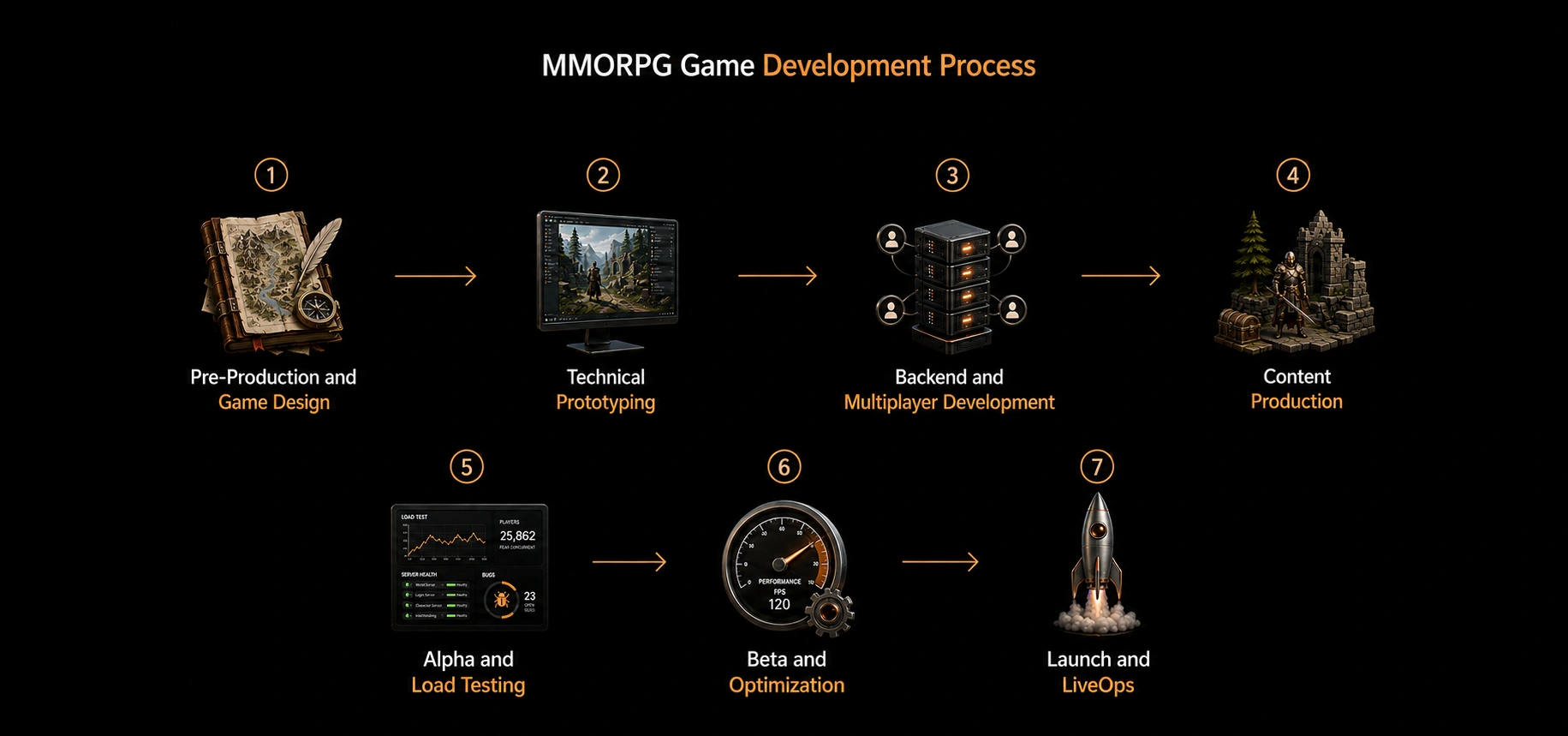
1. Pre-Production and Game Design
Create the Game Design Document (GDD), define gameplay loops, progression, characters, world structure, monetization, platforms, and technical requirements.
2. Technical Prototyping
Build a small multiplayer prototype to validate movement, combat, synchronization, persistence, and server performance.
3. Backend and Multiplayer Development
Develop authentication, player accounts, world servers, databases, inventory, social systems, matchmaking, and server-side gameplay logic.
4. Content Production
Develop environments, characters, animation, quests, items, NPCs, dungeons, and other gameplay content.
5. Alpha and Load Testing
Test gameplay systems separately from infrastructure. Measure concurrent connections, server CPU and memory usage, database response times, latency, packet loss, and synchronization.
6. Beta and Optimization
Use real-player testing to identify gameplay issues, bottlenecks, exploits, and progression problems.
7. Launch and LiveOps
After release, development continues through patches, content updates, events, balancing, monitoring, moderation, and infrastructure management. MMORPG development references consistently treat LiveOps as an ongoing production requirement rather than a final phase.
How Much Does MMORPG Game Development Cost in 2026?
The MMORPG game development cost depends on project scope rather than a fixed price per feature.
The major cost factors include:
| Game scope |
Very High |
| Multiplayer complexity |
Very High |
| Number of platforms |
High |
| Team size |
High |
| Cloud infrastructure |
Ongoing |
A small prototype can cost substantially less than a full commercial MMORPG. As an external industry reference, Game-Ace currently states that focused MMORPG prototypes/MVPs can start around $150,000, while larger projects increase according to world size, backend complexity, art, content, platforms, QA, and LiveOps.
Plan Your MMORPG Development Budget
Should You Build In-House or Use MMORPG Game Development Services?
The decision between internal development and external MMORPG game development services depends on technical expertise, budget, timeline, and long-term ownership requirements.
1. In-House MMORPG Development
An internal team provides direct control over the technology, codebase, development process, and long-term product knowledge.
However, building an MMORPG team internally may require specialists in:
- Game programming
- Backend engineering
- Network engineering
- Game design
- 3D art
- Animation
- QA
- DevOps
- Security
- LiveOps
Recruiting and coordinating all these disciplines can significantly increase the initial development effort.
2. Working With an External Game Development Company
An external game development company can provide access to multiple disciplines without requiring a complete internal team from day one.
This model can be useful for:
- Prototyping
- Backend engineering
- Multiplayer systems
- Art production
- QA
- Full-cycle development
- Team extension
However, technical documentation, IP ownership, source-code access, security practices, communication processes, and post-launch responsibilities should be clearly defined before development starts.
Prepare Your MMORPG for Launch with Security, LiveOps and Continuous Development
Before launch, an MMORPG must be tested for performance, security, scalability, and long-term stability. These processes also continue after launch through LiveOps.
- Load Testing: Test increasing player numbers to identify server and database bottlenecks.
- Network Testing: Check latency, packet loss, synchronization, and bandwidth usage.
- Security & Anti-Cheat: Validate server-side actions, authentication, transactions, and player activity.
- Stress Testing: Simulate peak scenarios such as mass logins, large PvP battles, and crowded zones.
- Server Monitoring: Track CPU, memory, crashes, latency, and concurrent connections.
- Content Updates: Continuously introduce quests, items, events, dungeons, and other content.
- Balance & Analytics: Use player data to improve progression, economy, gameplay balance, and performance.
- Ongoing Maintenance: Release patches, optimize infrastructure, fix exploits, and maintain security after launch.
Conclusion
The most reliable way to start MMORPG development in 2026 is to start with a focused gameplay loop, a small persistent environment, a tested multiplayer architecture and a realistic MVP.
Partner with MMORPG experts at ChicMic Studios that use a structured approach to build an architecture that grows with the player base without forcing the entire game to be rebuilt. Also, they provide continuous testing. Playtesting for game development is an important part of validating gameplay, identifying issues and improving the overall player experience.
Once those foundations work under real multiplayer conditions, additional zones, classes, social systems, content, economies, and LiveOps features can be added incrementally.
FAQs
1. How much does MMORPG game development cost in 2026?
The MMORPG game development cost depends on world size, multiplayer architecture, platforms, content, team size, infrastructure, and LiveOps requirements. A focused MVP costs significantly less than a large-scale persistent MMORPG costing $150,000.
2. How long does MMORPG game development take?
MMORPG game development can take several months for an MVP and several years for a full-scale commercial game. The timeline depends on technical complexity, content scope, platforms, and team size.
3. What technology is best for MMORPG game development?
Unity and Unreal Engine can both support MMORPG projects, while the backend, database, networking, and cloud stack should match the game’s scalability requirements.
4. What is full-cycle MMORPG game development?
Full-cycle MMORPG game development covers everything from game design and prototyping to programming, multiplayer development, QA, deployment, and LiveOps. It can include art, backend, networking, DevOps, and post-launch support.
5. What are MMORPG game development services?
MMORPG game development services can include game design, multiplayer development, backend engineering, 3D art, networking, QA, cloud infrastructure, and LiveOps. The required services depend on the project’s scope and development stage.
6. How do I choose a game development company for an MMORPG?
Choose a game development company like ChicMic Studios with experience in multiplayer architecture, backend systems, networking, QA, and scalable infrastructure. Also evaluate its technical expertise, development process, game development portfolio, and post-launch game development services.
Ready to Build a Scalable MMORPG in 2026?