How to Build a Telegram Tap-to-Earn Game Like Hamster Kombat in 2026
Key Takeaways
- Core Value: Hamster Kombat succeeds because it controls progression speed, rewards timing, and player expectations, not because of fast or repetitive tapping.
- Extensive Services: A working tap-to-earn game needs Telegram Mini Apps, server-side validation, upgrade pacing, bot protection, referrals, and live operations designed together.
- Business Impact: Well-paced economies improve retention, protect trust, and allow long-term growth without relying on spam, hype, or short-term incentives.
- Use Cases: This model fits community-driven products, loyalty systems, Web3-adjacent platforms, and any Telegram experience built around repeat engagement.
- Future Direction: Tap-to-earn games in 2026 will focus on squad mechanics, real-time performance, behavior-based security, and live operations that refresh without inflation.
Introduction
The Hamster Kombat Telegram tap-to-earn game changed how Telegram was used as a gaming platform. What started as a simple tapping experience became a well-thought-out progression economy that brought in millions of players every day. Making a comparable game in 2026 does not mean copying graphics or tapping mechanisms. It means recreating the internal systems that made Hamster Kombat work and updating them to meet the needs of modern platforms, users, and expectations.
This blog explains how to create a Telegram tap-to-earn game similar to Hamster Kombat using real limitations, real product decisions, and scalable game economy planning for 2026.
If you are planning a wider product roadmap around game apps, monetization, and scalable player systems, you can also explore our game development services for end-to-end production support.
Understanding What Hamster Kombat Actually Is
Before you build a Telegram tap-to-earn game in 2026 , remember that Hamster Kombat is not essentially a tapping game. Tapping is only the first interaction. What actually happens is a managed, phased economy where every activity is deliberately slowed, paced, and held back.
The game is designed to control the speed at which players progress rather than the rate at which they tap. Taps are worth very little by themselves. The real value comes from how taps result in progress over time, how progress is deliberately slowed, and how future benefits are suggested but never guaranteed.
All systems in the Hamster Kombat Telegram tap game are designed to control speed, promote daily return behavior, and create anticipation. Even if the interface looks similar, your game will feel empty without this foundation.
Building the Tap and Energy System the Hamster Kombat Way
The tap and energy structure is what separates a lasting Hamster Kombat-style Telegram tap-to-earn game from short-lived clones. Energy should limit engagement naturally instead of forcing users to play endlessly. This trains players to return multiple times a day without burning out.
This approach works well for Telegram Mini App behavior in 2026, where short and repeated sessions are better than long, continuous play. Energy is now a pacing tool, not just a constraint. It dictates how often players check in and how long they stay engaged.
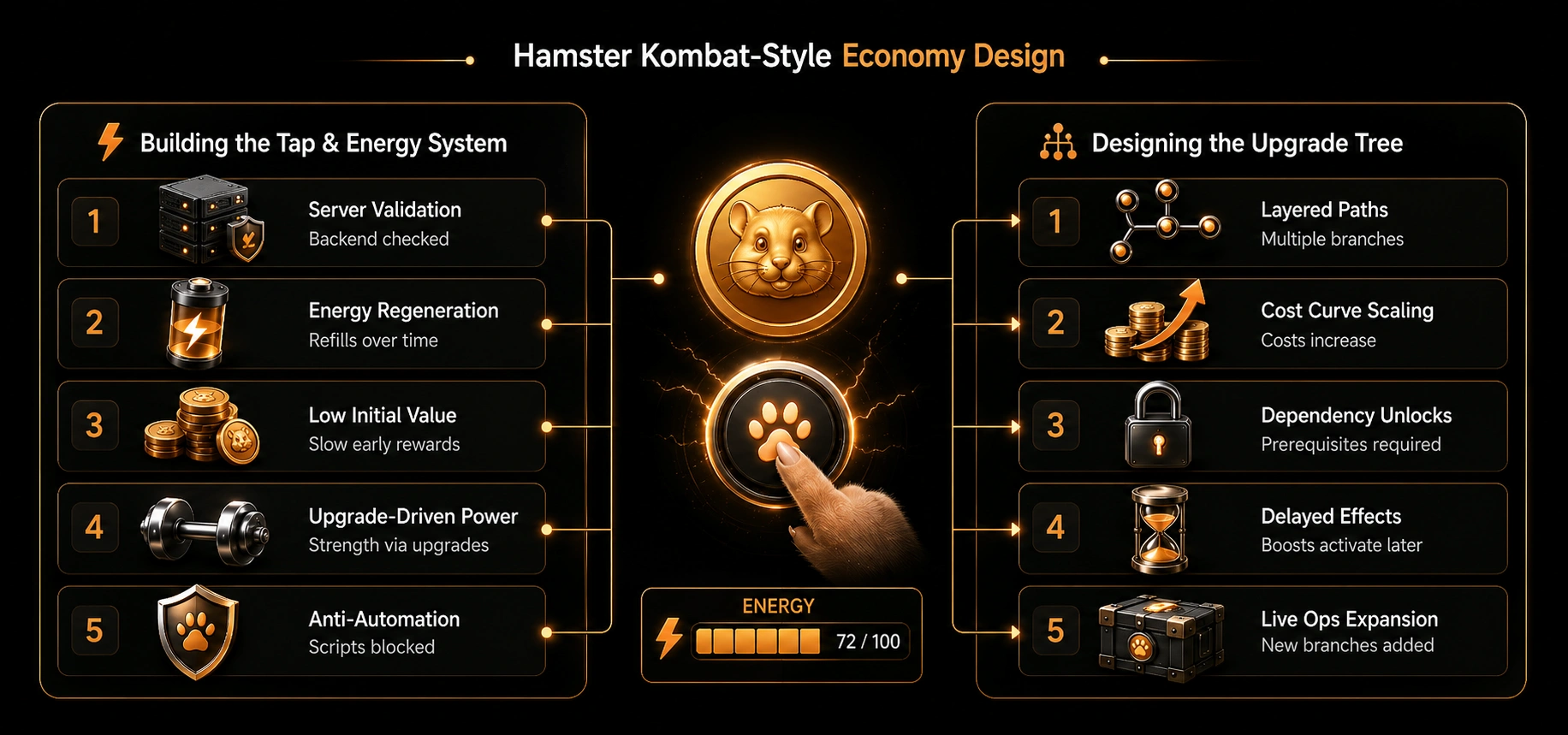
1. Server-Side Validation
Rewards, cooldowns, and energy limits must stay consistent across all devices. Each tap should be checked on the backend so users cannot manipulate progress from the client side.
2. Controlled Energy Regeneration
Energy should refill over time. This prevents players from completing all progress in a single session and creates natural return points throughout the day.
3. Low Initial Value
Early taps should not feel overly rewarding. This encourages patience and shifts the player’s focus toward upgrades rather than quick, repetitive tapping.
4. Upgrade-Driven Power
Tap strength should increase only through upgrades. This makes progress feel earned and prevents excessive activity from breaking the economy.
5. Anti-Automation Design
Strict energy logic and server checks make scripted tapping worthless. This protects the economy from inflation, fake growth, and unfair player advantages.
Launch Tap-to-Earn Game That Keeps Players Coming Back
Designing the Upgrade Tree That Controls Progression
In a Hamster Kombat Telegram tap-to-earn game, the upgrade tree is more about permission to proceed than pure power scaling. Each upgrade secretly determines how much progress a player can unlock each day, week, and season. Upgrade systems in 2026 should slow momentum without frustrating users. They add friction through cost increases, cooldowns, and dependency chains. This creates a sense of well-earned achievement where progress matters because it takes time, not because it happens instantly. A good upgrade tree makes time a resource and patience a skill. That is what supports long-term retention instead of short-term spikes.
- Layered Upgrade Paths: Upgrades should be categorized so players manage multiple progression paths instead of maxing out one stat.
- Cost Curve Scaling: Each upgrade should cost more in a non-linear way, making quick progression harder while keeping the next goal visible.
- Dependency-Based Unlocks: Some upgrades should unlock only after specific prerequisites are met. This keeps progression aligned with the intended pace.
- Delayed Upgrade Effects: Some improvements can activate after a time delay to increase anticipation and reduce instant reward dependency.
- Live Ops Expansion: New upgrade branches can be added during operations without upsetting the balance of the core economy.
If your upgrade system includes blockchain assets, token access, or ownership-based rewards, our blockchain game development team can help structure the gameplay economy with stronger technical foundations. For market research, you can also explore our list of top blockchain-based gaming companies of 2026 to compare how leading studios approach Web3 game production.
Implementing Passive Earnings Without Letting Players Go Idle
Passive earnings in a Hamster Kombat Telegram tap game should reinforce daily engagement instead of replacing active play. To make progress, users still need regular interaction. Earnings must be limited, time-bound, and tied to improvements. By 2026, passive systems will rely on efficiency decay and claim windows to bring people back. Earnings should not keep increasing forever. They should slow down when users are not active, which protects the economy and encourages regular check-ins.
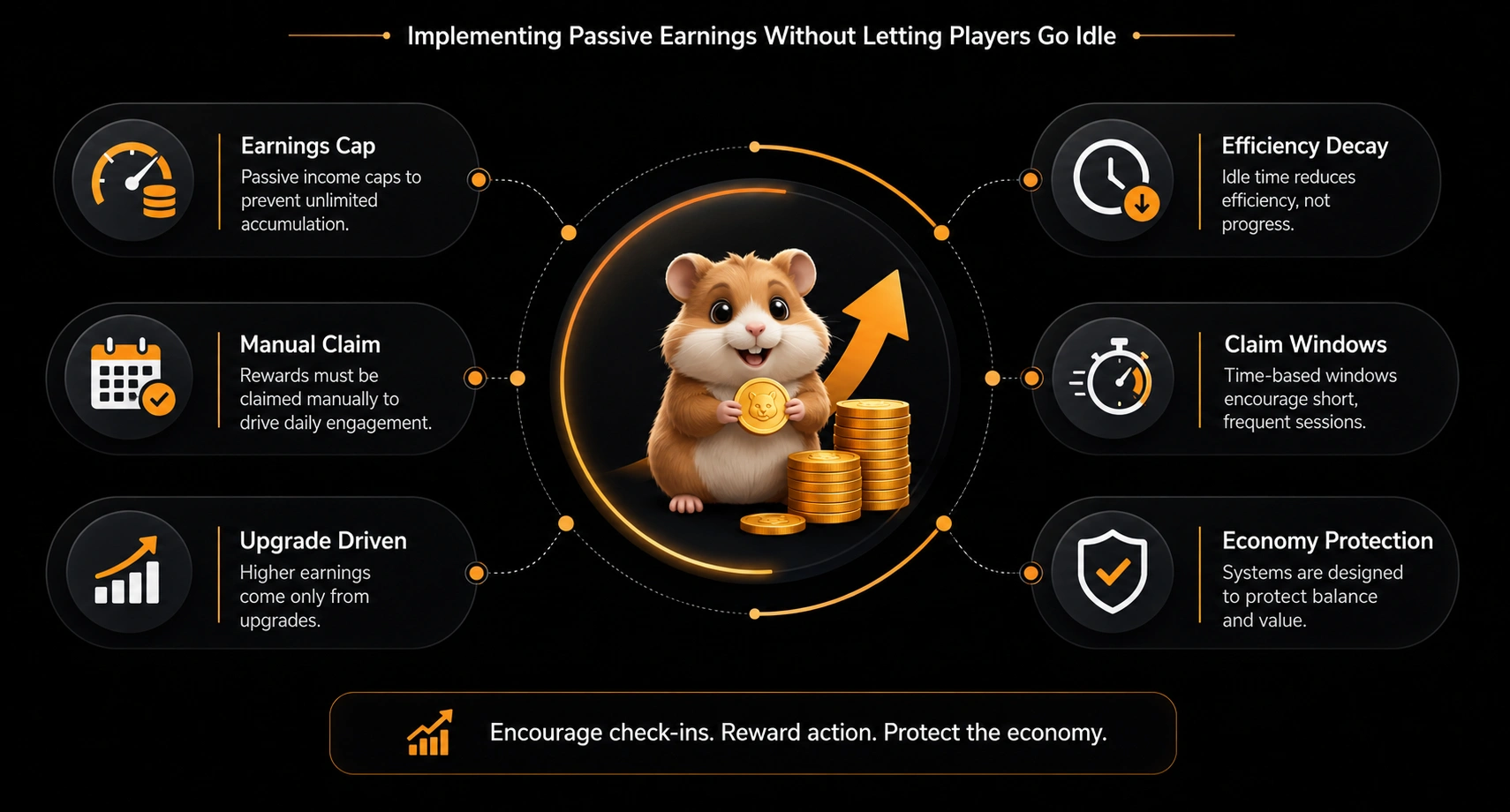
- Passive income should not accrue past a specific cap.
- Rewards should be claimed manually to encourage daily participation.
- Improved earnings should come from upgrades, not just time spent away.
- Long idleness should reduce earning efficiency instead of blocking progression completely.
- Time-based claim windows should encourage short and frequent gaming sessions.
Structuring Rewards the Way Hamster Kombat Does in 2026
Rewards in a Hamster Kombat Telegram tap game are designed as a long-term outcome, not an immediate promise. The approach connects potential rewards to participation quality, progress consistency, and seasonal performance. This strategy prioritizes eligibility over guaranteed payouts. It supports legal and reputational safety, keeps players involved without raising false expectations, and protects the economy from exploitation.
1. Eligibility-First Design
Rewards should be based on consistent participation, rank stability, and season activity, not immediate actions. This reduces legal risk and avoids speculative expectations.
2. Season Snapshot Logic
Player status should be recorded at predetermined season checkpoints. This locks eligibility transparently and prevents last-minute activity spike manipulation.
3. Tier-Based Qualification
Progress bands should be cumulative. Users can qualify for rewards based on long-term consistency rather than short-term grinding.
4. Deferred Disclosure Model
Reward values can remain undisclosed until distribution. This builds anticipation, reduces speculation, and keeps engagement high throughout the season.
5. Transparent Messaging Layer
Clear in-app messaging builds trust by explaining qualification rules, deadlines, and uncertainty without promising financial outcomes. For token-based reward models, you can also review our play-to-earn game development solutions to understand how reward logic can be planned safely and sustainably.
Using Telegram Mini Apps for Hamster Kombat-Level Performance
Hamster Kombat works because everything happens in real time. Upgrades give instant feedback, taps are answered quickly, and the interface never feels disconnected from what the player is doing. This responsiveness is not just visual polish. It directly impacts perceived value, trust, and player retention. In a tap-to-earn environment, small delays reduce the sense of progression and make rewards feel less real. By 2026, the best way to reach that level of performance is through Telegram Mini Apps. Bot-based experiences are inherently laggy and often break flow. Mini Apps allow state updates in real time, smooth transitions, and frontend behavior that matches server-confirmed actions. Tap-to-earn games are about speed, trust, and consistency. Because micro-interactions directly affect retention, our blog on the importance of user experience in games is also useful when planning tap feedback, animations, and player trust signals.
- Constant tap feedback reassures players that every action is recorded.
- Instant UI updates reduce perceived waiting between taps, upgrades, and reward confirmations.
- Fluid animations highlight progress milestones without artificial delays.
- Client-server synchronization prevents visual desynchronization between user actions and backend validation.
- Short play cycles with low-latency interactions drive higher session frequency and retention.
If the game needs wallet access, user identity, token utility, or decentralized interactions, Web3 dApp development can extend the Telegram experience into a stronger digital product ecosystem. For lightweight browser-based launches, HTML5 game development can also support smooth gameplay inside web-first and Telegram-style environments.
You can also read our guide on how Web3 games are built to understand the architecture, tools, and backend systems behind blockchain-enabled gaming products.
How Hamster Kombat Grows Without Spamming
The referral system in Hamster Kombat is based on advancement rather than advertising. Players share the game because it advances their own progress, unlocks more efficiency, speeds up improvements, or creates group-based advantages. Squad mechanics make this model stronger in 2026 because they prioritize group activity over individual invitations. Growth feels natural because it is linked to gameplay strategy rather than forced marketing tactics.
- Progress-Linked Sharing: Invites should improve long-term growth incentives instead of offering throwaway one-time bonuses.
- Scaling Referral Value: Long-term participation should increase referral value, making steady engagement more important than early invites.
- Squad-Based Progression: Shared bonuses should unlock through group performance, encouraging cooperative play.
- Purpose-Driven Invites: Players should share to maximize their own progress, not because the game pushes spammy promotion.
- Anti-Spam Design: Avoid instant incentives and mass-invite abuse so referral growth stays useful and balanced.
Preventing Bots in a Tap-Based Economy
Bot prevention is one of the most important parts of the economic design of a Telegram tap-to-earn game like Hamster Kombat. Automated tapping, scripted claiming, and upgrade abuse can destroy balance before the game reaches scale. In 2026, successful games analyze player behavior continuously. They look at tapping rhythm, energy spending, upgrade patterns, and reward claiming behavior. To preserve fairness without affecting legitimate users, calculations should run on the server side and suspicious patterns should be slowed or limited in a subtle way.
1. Behavior Pattern Analysis
Monitor tapping rhythm, session time, upgrade order, and claim frequency to identify automation without relying on invasive verification methods.
2. Server-Side Rewards
All rewards, earnings, and progression calculations should happen on the backend. This prevents client-side manipulation and removes the value of modified programs.
3. Adaptive Throttling Logic
Suspicious accounts should not always be instantly banned. Gradual throttling reduces false positives and slowly limits mass bot activity.
4. Energy Abuse Detection
Abnormal energy use patterns can indicate automation attempts. Systems should detect these signals before economic damage occurs.
5. Trust Preservation Layer
Consistent anti-bot enforcement protects fair players, keeps progression stable, and maintains trust in the game economy.
Planning Live Operations Before Launch
A Telegram tap-to-earn game like Hamster Kombat is never meant to stay the same after launch. Live operations are not an add-on. They are part of the main product design. After the initial novelty wears off, seasonal changes, temporary boosts, limited-time upgrades, and surprise features keep players interested. Without these systems in place from day one, even good games can lose momentum quickly. Live operations must be planned in line with the economy, not added on top of it. Temporary content should not destroy upgrade balance, permanently inflate rewards, or speed up progression too much. Strong live ops support long-term pacing, fairness, and retention between seasons while keeping the game fresh.
- Seasonal resets should refresh engagement loops without wiping player progress.
- Temporary upgrades should create urgency while keeping the long-term economy balanced.
- Event multipliers should increase activity without permanently inflating earning rates.
- Dormant players can be re-engaged through surprise events without full feature releases.
- Pre-planned live operations tooling enables fast iteration without harming the core economy.
For studios building experiences across Android, iOS, and Telegram, our mobile game development services can help align gameplay, performance, and retention systems across platforms. If the same game needs to run inside browsers or web-based communities, web game development can help extend the experience beyond Telegram without rebuilding the product from scratch. For broader platform planning, our article on how cross-platform gaming is transforming the industry explains why consistent progression across devices matters for modern players.
Design Scalable In-Game Economies That Keep Players Engaged
Why Execution Matters More Than the Idea
In 2026, the Telegram tap-to-earn market already understands the Hamster Kombat concept. The difference between a successful game and an unsuccessful one is execution. Concepts are no longer the differentiator. Results depend on how systems behave in real-world situations and how consistently they scale. To create this type of game, you need live operations, backend scalability, economy design, and Telegram Mini App expertise. Many creators work with an experienced game development company that provides expert game development services for Telegram-based tap economies. Good execution builds long-term longevity. Poor execution kills trust quickly. If your project needs real-time gameplay, high performance, or cross-platform scalability, our Unity game development team can support the technical side of production.
Final Thoughts
Making a Telegram tap-to-earn game like Hamster Kombat in 2026 requires more than taps, graphics, or surface mechanics. It is about controlling how people receive rewards, how fast they move forward, and how intentional friction builds suspense.
Players advance through energy systems, upgrade trees, passive earnings, referrals, and live ops, while taps simply trigger actions. When these systems are intentionally slowed down, people return every day because they feel like they are earning progress instead of rushing through it.
When systems match real Telegram user behavior and execution stays disciplined, the product feels natural, not copied. When incentives are properly delayed, economies remain balanced, automation stays controlled, and community participation increases long-term engagement. The secret to lasting success in 2026 is to build a controlled economy where time, patience, and scale matter more than short-term hype.
To see how AI is also reshaping modern gameplay systems, read our blog on AI-powered game systems .
Frequently Asked Questions
1. What actually makes the Hamster Kombat Telegram tap-to-earn game different from other tap games?
Hamster Kombat is built around progression control, not tapping speed. The economy, upgrades, and pacing matter more than the tap itself.
2. Can you build a Hamster Kombat-style Telegram game without copying its mechanics?
Yes. Success comes from recreating the underlying systems like energy pacing, upgrade authorization, and delayed rewards rather than copying visuals or flows.
3. Are Telegram Mini Apps required for tap-to-earn games in 2026?
Yes. Telegram Mini Apps are essential because bot-based experiences cannot deliver the real-time feedback and low latency this genre demands.
4. How do tap-to-earn games prevent bots without banning real users?
Modern games rely on behavior pattern analysis, server-side validation, and adaptive throttling instead of hard limits or aggressive bans.
5. Why do most Hamster Kombat clones fail after launch?
They copy tapping but ignore economy balance, live operations, and progression pacing. Users churn once the novelty wears off.
6. How important are live operations in a Telegram tap-to-earn game?
Live operations are critical. Seasonal events, temporary upgrades, and surprise boosts keep engagement high without inflating the core economy.
7. Do tap-to-earn games still work without instant rewards?
Yes. Delayed rewards can build more trust and retention by encouraging consistent participation rather than short-term grinding.
8. How does referral growth work without spamming users?
Referral systems tied to progression and squad performance feel strategic, encouraging organic sharing instead of forced marketing behavior.
9. What skills are required to build a scalable Telegram tap-to-earn game?
You need expertise in economy design, backend scalability, Telegram Mini Apps, live operations, and long-term progression planning.
10. Is working with a game development company necessary for this type of game?
For most teams, yes. Building a stable tap-to-earn economy requires experienced game development services to avoid costly execution mistakes.
Get a Free Tap-to-Earn Game Development Consultation