Key Takeaways
- Ride-hailing is a two-sided marketplace, so driver supply comes before rider demand.
- Costs run from $15K for white-label to $200K+ for custom, over 2 weeks to 6+ months.
- Maps API bills can surprise you: $800-$5,000 a month depending on ride volume.
- Commission versus subscription shapes driver retention, so model unit economics per ride.
- Onboard 50–100 drivers before opening to riders, and budget $5K-$20K for acquisition.
- Cross-platform keeps MVPs affordable. Go native only when you need deep device access.
Introduction
Ride-hailing stopped being a Silicon Valley novelty a long time ago. It’s a mature global category now, and founders and fleet operators everywhere are asking the same thing: could we build our own? Uber clone app development is where most of them start, and that’s a sensible place to begin.
The catch is that a ride-hailing app is a two-sided marketplace. Riders leave when there are no drivers nearby, and drivers leave when there are no riders paying. Software doesn’t fix that on its own. Plenty of first-time builders find this out only after spending most of the budget on features nobody has used yet.
This guide walks through the features a clone needs, what it costs, which tech stack holds up under load, and which business model keeps the numbers healthy. It also deals with the cold-start problem directly, because driver supply decides whether a launch survives. Use the figures to stress-test your own business case before you commit any money.
Planning to Launch Your Own Uber-Like Taxi Booking App?
Core Features Every Ride-Hailing App Needs
A ride-hailing product is really three products sharing one backend. Getting that split right is the first step in scoping Uber clone app features. The market is big enough to explain the interest: research firm GMI Insights puts it at USD 188.6 billion in 2025, heading toward USD 489.5 billion by 2035. It also explains the competition.
1. The Rider App
Riders book, see a fare estimate, watch the driver arrive, pay in the app, and leave a rating. Speed matters more than anything else here. Someone who waits too long for a match will open a competitor’s app instead.
2. The Driver App
Driver and passenger app development have different priorities. Drivers need quick ride acceptance, turn-by-turn navigation, an earnings dashboard, document upload, and an online/offline toggle. Battery drain and background location accuracy decide whether they keep the app open all shifts.
3. The Admin Panel
The admin panel handles driver onboarding, pricing rules, surge settings, commissions, disputes, and analytics. Fleet operators tend to underestimate it, but it’s where margins get managed day to day. A weak panel means manual spreadsheets, slow driver approvals, and pricing mistakes that quietly eat into revenue.
4. Minimum Feature Checklist
- Real-time GPS tracking
- Driver and rider matching
- Upfront fare estimation
- Multiple payment methods
- Ratings and reviews
- Push notifications
- SOS and trip sharing
- Automated driver payouts
Cost Breakdown: What You Actually Pay For
What you pay depends on how much you build and how much you buy. Uber clone app development costs run from about $15K for a configured white-label product to $200K or more for a platform built to scale. Taxi app development cost also moves with region, team model, and compliance needs.
| Tier |
Cost Range |
Timeline |
Best For |
| White-label |
$15k-$25k |
2–6 weeks |
Fleet operators testing one city |
| Custom MVP |
$30K-$50K |
3–5 months |
Startups validating a unique model |
| Full-featured |
$60K-$200K+ |
6+ months |
Funded platforms planning multi-city scale |
What Moves the Price
On-demand ride booking app development gets expensive in a few predictable places: custom matching and dispatch logic, surge pricing, split payments and driver payouts, multi-city and multi-currency support, and how deep the admin panel goes. Two native apps cost more than one cross-platform codebase. Be wary of quotes far below these ranges. They usually leave out payments, admin tooling, or load testing, and those come back later as change requests.
Maps usage is the line item most budgets miss. At roughly 1,000 rides a day, expect $800-$2K a month in Google Maps API charges. At 10,000 rides a day, that climbs to $5K-$15K a month. Google lists per-request rates on its Maps Platform pricing page, and route recalculations and autocomplete calls drive most of the bill. Caching, session tokens, and using Mapbox for some features can bring it down.
Want an Accurate Ride-Hailing App Development Cost?
Tech Stack: What Powers a Ride-Hailing App
A ride hailing app tech stack has one genuinely hard job: tracking thousands of moving locations that update every few seconds. The rest is fairly standard. Teams that build it like an ordinary CRUD app tend to hit a wall at a few hundred concurrent trips.
1. Mobile Layer
Cross-platform mobile app development keeps an MVP affordable because one team ships to both stores. Native builds only pay off when you need deep device features or peak performance on specific handsets, which is rarely the case at launch. A shared codebase also means one bug fix reaches every user on both stores at once.
For the rider and driver apps, Flutter app development gives you smooth map animation and a consistent UI from a single codebase, and the two apps can share components. It compiles to native code, which helps on the mid-range Android phones many drivers use in price-sensitive markets. That matters, since a laggy driver app costs you supply.
Teams with JavaScript talent often lean toward React Native app development, which can also share logic with a React-based web admin dashboard. The trade-off is that complex map overlays sometimes need native modules, so ask your team how they plan to handle those.
2. Backend and Data Layer
Node.js suits the backend because its event-driven model copes well with many open WebSocket connections, and WebSockets are what push driver locations and trip status to riders in real time. Google Maps or Mapbox covers routing and ETAs. PostgreSQL with PostGIS handles geospatial queries like finding the nearest available drivers, and Redis often caches live driver positions to keep matching fast.
Payments need marketplace logic, not just a checkout button. Stripe Connect splits each fare between the platform and the driver, runs payouts, and handles driver onboarding and verification.
The Business Model: Commission, Subscription, or Hybrid
The ride hailing business model you pick shapes your driver supply, your margins, and even your app architecture. There are three realistic options.
1. Commission
The classic approach takes 20–25% of each fare. It scales with ride value and is easy to explain. The downside is driver resentment, which makes supply harder to hold once a competitor offers better terms.
2. Subscription
Drivers pay a flat daily or monthly fee and keep the whole fare. Namma Yatri popularised this zero-commission idea in India, and Rapido followed with low daily access fees. Bigger rivals then moved toward similar plans, as Inc42 reported in its analysis of the zero-commission shift. Revenue becomes predictable, though it now depends on driver volume rather than ride value.
3. Hybrid and Unit Economics
Many operators now mix a low subscription with a small per-ride fee or paid add-ons. Whatever you choose, work out the unit economics per ride before launch. Take the average fare and subtract payment processing, maps costs, insurance, support, and driver incentives. If what’s left is close to zero, scale won’t rescue it. As an illustration, an $8 fare at 20% commission earns the platform $1.60 before processing fees, maps charges, and incentives, and on short trips those can swallow most of it.
The same math applies to ride sharing app development, where pooled rides improve utilisation but complicate matching and payouts.
The Cold-Start Problem: Driver Supply Before Rider Demand
Most failed ride-hailing launches don’t fail on technology. Riders open the app, see no cars, and never come back. In Uber-like app development, supply has to come first.
1. Why You Need 50–100 Drivers First
Plan to have 50–100 active drivers in a launch zone before you open the app to riders. Below that, waits stretch, cancellations climb, and the first reviews turn sour. Taxi booking app development projects led by existing fleet operators have a real edge here, because the drivers already exist.
Budget for acquisition, not just onboarding. As a rough planning figure, winning and keeping each driver can cost $50-$200 in incentives, guaranteed minimum earnings, and onboarding support. A 100-driver launch then needs $5K-$20 on top of the app build. Plan for it before launch instead of discovering it mid-rollout.
2. Density Beats Coverage
Launch in one dense zone rather than a whole city. Guarantee drivers a minimum income for the first few weeks, and let riders in gradually as supply settles. Globally the category is concentrated, with a handful of platforms taking most installs and trips. Newcomers win on local density, not global reach, so owning one neighbourhood beats a thin presence across a metro.
Development Process and Timeline
A disciplined process keeps a custom build inside the 3–5 month MVP window. Here are the seven steps we recommend.
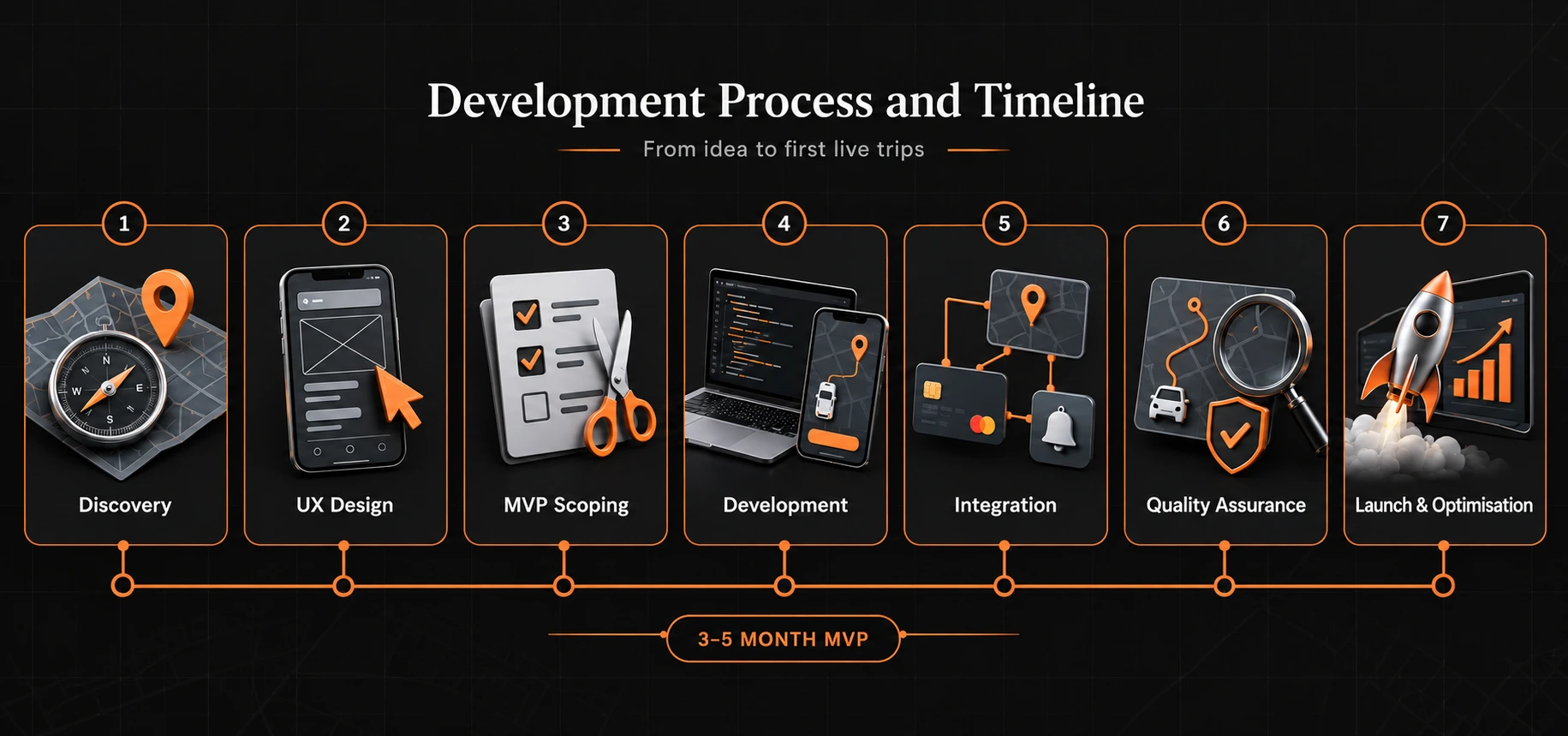
1. Discovery
Define the target city, vehicle types, pricing logic, and compliance needs. Settle the business model now, since it shapes the data model and payouts. Agree on success metrics too, such as average pickup time and driver retention, so the team builds toward something measurable.
2. UX Design
Map the rider and driver journeys, then prototype them. Good UI/UX design cuts the number of taps needed to book a ride and keeps driver screens usable while a car is moving.
3. MVP Scoping
Trim the feature list to booking, matching, tracking, payment, and ratings. Ride pooling, scheduled rides, and loyalty rewards can wait until real trips prove the core loop works.
4. Development
Build the backend, matching engine, and mobile apps in parallel sprints. Native iOS app development becomes relevant if you later need advanced background location handling or Apple-specific features. Either way, load-test the location pipeline early, well before the interface is polished, because that is where scaling problems show up first.
5. Integration
Connect maps, payments, SMS, push notifications, and identity checks. On the driver side, Android app development deserves extra care because many drivers use budget handsets whose aggressive battery management can kill background tracking. Test across manufacturers and OS versions, and give drivers clear in-app guidance on battery and permission settings. This is also when payout schedules, tax reporting, and driver verification get wired into the admin panel.
6. Quality Assurance
Test real routes, weak networks, and payment failures in the field. Professional QA services should cover load testing, GPS drift, and edge cases like a driver cancelling mid-trip. Run a closed pilot with real drivers before going public. Field testing turns up problems emulators never will, from dead zones to confusing pickup pins at big venues.
7. Launch and Optimisation
Launch in a single zone, watch wait times and cancellations daily, and keep iterating. Once you have trip data, AI development can sharpen ETA accuracy, demand forecasting, dynamic pricing, and fraud detection. Start with simple rules and add machine learning once you have enough trips to train on. For location-data architecture, the PostGIS documentation is a handy technical reference.
How to Choose a Ride-Hailing App Development Partner
Your partner should understand marketplaces, not just mobile apps. Custom ride hailing app development services vary widely, so ask for evidence instead of promises. Look for a live ride-hailing or on-demand portfolio, maps and routing experience, split-payment and payout expertise, real-time scaling references, and clear post-launch support terms.
Ask how they’d handle your first 100 drivers, not just your first 100 screens. Request references from clients who have launched, and ask what went wrong in those launches as well as what went right. A capable ride hailing app development company will answer with a launch plan, a cost model, and an honest view of the risks.
Concluding Note
You can build a ride-hailing product at almost any budget, from a $15K white-label launch to a $200K+ custom platform. The harder question is whether the marketplace works once it’s live. Budget for maps costs, pick a model that keeps drivers earning, and plan supply before demand. Go white-label if speed matters most, or a custom MVP if your model is genuinely different. Technology is only half of a marketplace. The other half is people.
Handled well, Uber clone app development gives founders and fleet operators a faster, cheaper way into mobility. Start small, launch dense, and let real trip data guide each next investment. When you’re ready to scope your project, talk to a team that has shipped location-based marketplaces before.
Frequently Asked Questions
1. What does an Uber clone app cost?
White label products cost between $15k and $25k and can be built in 2-6 weeks. Custom MVPs are between $30K and $50K for 3-5 months. Multi-city platforms start above $60K and go back to $200K for six months in development time.
2. How long does it take to build a ride-hailing app?
White-label: 2-6 weeks to live, custom MVP: 3-5 months, and full-featured platform: 6+ months. The most common bottlenecks are payment splitting and map integration.
3. What features does an Uber clone need?
Passenger + driver app + admin panel with the same backend: booking, tracking, payment, ratings; acceptance, navigation, earnings, doc uploading; onboarding, pricing, commissions, disputes, analytics. Loyalty, scheduling, and pooling can be added in later.
4. Which business model works best?
The traditional, commission-based model of 20-25% per ride, is bad for retention of drivers. Subscription is a hybrid that provides predictability and loyalty. Model unit economics first: an $8 fare at 20% commission leaves $1.60 before processing, maps, and incentives.
5. How many drivers do I need before launch?
Have 50-100 active drivers before allowing passengers into your launch area. Count on spending $5,000-20,000 on purchases (incentives, guaranteed minimum wages, etc.).