Top 2D & 3D Animation Companies for Your Next Animation Project
Key Takeaways
- 2D and 3D animation companies offer different capabilities, so the right choice depends on your project’s creative, technical, and business requirements.
- ChicMic Studios can be considered for projects that combine animation with interactive and game-development requirements.
- Choosing between a 2D, 3D, or a full Game Development depends on the scope of the project.
- Before hiring an animation partner, evaluate portfolio relevance, technical capabilities, communication, timeline, scalability, and expected deliverables.
Introduction
Choosing the right animation partner to hire in 2026 can significantly affect the quality, timeline, and overall impact of your project. Whether you need an explainer video, a cinematic sequence, a product visualization, a game character, or an immersive 3D experience, the right production team should have the technical expertise and creative capability to match your requirements.
Today, 2D and 3D animation companies work across industries such as entertainment, advertising, education, healthcare, gaming, architecture, and technology. While 2D animation is often preferred for stylized storytelling and explainers, 3D animation provides greater depth, realism, and flexibility for products, environments, characters, and interactive experiences.
Rather than choosing a Top 2D 3D animation company based only on its reputation, businesses should consider its portfolio, production pipeline, specialization, technology stack, communication process, and experience with similar projects.
Why Choose 2D & 3D Animation for Your Project?
Animation gives businesses a way to communicate ideas that may be difficult to explain through conventional video or static graphics. The choice between 2D and 3D depends largely on the project’s objective, visual style, audience, and technical requirements.
2D animation uses illustrations, shapes, characters, typography, and motion to create engaging visual stories. It is widely used for explainer videos, educational content, advertisements, social media campaigns, training materials, and character-based storytelling. Techniques can include traditional frame-by-frame animation, digital 2D rigging, motion graphics, and compositing.
3D animation, on the other hand, creates objects and environments within a three-dimensional digital space. A typical workflow may involve modeling, UV mapping, texturing, rigging, lighting, animation, rendering, and compositing. It is particularly useful for product visualization, architectural walkthroughs, medical visualization, game cinematics, simulations, and realistic character animation.
Many modern 2D & 3D animation companies also use hybrid workflows. A project might combine 3D product models with 2D graphics, or use 3D environments with a stylized 2D visual treatment. This flexibility allows creators to select the right technique for each part of a project rather than relying on a single animation style.
ChicMic Studios’ 3D Animation in Action
This 3D animation example showcases how character movement, environments, cinematic storytelling, and visual effects can come together to create an engaging experience. The sequence follows a warrior girl as she chases a mysterious device that leads her through different locations.
Watch the 3D animation example:
Bring Your 2D or 3D Animation Idea to Life
How to Choose the Right 2D and 3D Animation Company
Finding the right animation studio requires more than looking at its showreel.
Start by reviewing relevant portfolio work. A company experienced in cinematic character animation may not necessarily specialize in technical product animation or corporate explainers. Look for projects that demonstrate capabilities similar to your requirements.
The production pipeline is another important consideration. Ask whether the studio handles concept development, storyboarding, modeling, animation, rendering, compositing, sound design, and post-production internally or through external partners.
Technology also matters. Depending on the project, an animation team may work with tools such as Blender, Maya, Cinema 4D, 3ds Max, Houdini, Adobe After Effects, Toon Boom Harmony, Unreal Engine, or Unity.
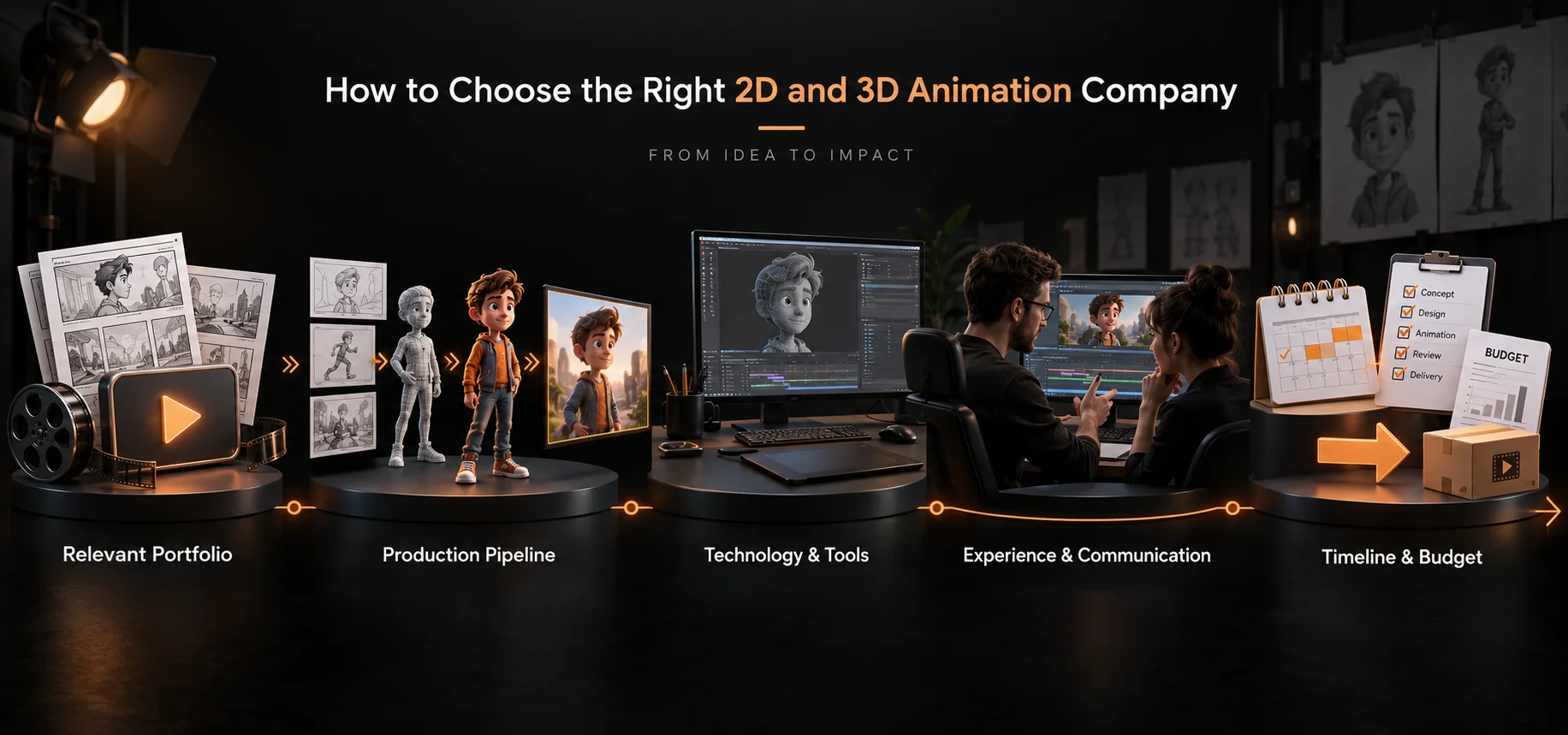
You should also evaluate:
- Industry experience
- Character and environment capabilities
- 2D and 3D production expertise
- Rigging and animation capabilities
- Rendering and compositing workflow
- Project management and communication
- Revision process
- Delivery formats
- Timeline and scalability
- Budget transparency
The right 2D and 3D animation companies should be able to explain not only what they can create, but also how they will take your project from concept to final delivery.
Top 2D & 3D Animation Companies to Consider
The animation industry includes studios with very different specialties. Some focus on feature films and cinematic storytelling, while others specialize in advertising, explainers, gaming, VFX, or business communication. The following companies represent different areas of the animation ecosystem.
ChicMic Studios is a relevant option to consider when a project requires animation alongside interactive digital production. For a 2D game development company, animation is closely connected to the overall game-production pipeline. Character design, sprite animation, environments, UI elements, visual effects, and game-ready assets all need to work together within the chosen game engine.
For projects requiring 3D Game development services, the requirements become more detailed. This makes the relationship between animation and game development important. A Game Development company may need animation expertise not only for promotional cinematics but also for the actual playable experience.
For businesses comparing 2D and 3D animation companies, ChicMic Studios can therefore be considered when the project requires a combination of visual content and interactive development. Before selecting a studio, however, clients should review its portfolio for work that closely matches their specific requirements, whether that involves 2D animation, 3D assets, character development, mobile games, or broader game development services.
Turn Your Animation Concept Into a Finished Experience
2. Pixar Animation Studios
Pixar Animation Studios is widely associated with feature-length 3D computer animation and character-driven storytelling. Its production approach demonstrates how 3D animation can combine sophisticated character rigs, digital environments, simulation, lighting, rendering, and storytelling. Pixar’s work is particularly relevant as a reference for projects requiring cinematic character animation and highly developed visual worlds.
For businesses or production teams studying high-end 3D animation, Pixar also provides an example of how technical production pipelines and creative storytelling can work together at large scale.
3. Blur Studio
Blur Studio is known for animation, visual effects, commercials, and game cinematics. The studio’s work demonstrates the application of 3D character animation, digital environments, effects, lighting, and cinematic rendering. Game cinematics are particularly demanding because they often require film-quality storytelling while representing interactive-game worlds and characters.
For projects involving cinematic trailers, character-driven sequences, or high-end game visuals, Blur’s production work is a useful benchmark for what modern 3D pipelines can achieve.
4. BUCK
BUCK operates at the intersection of design, animation, branding, and visual storytelling.
Its work spans 2D and 3D animation, motion design, illustration, typography, and commercial content. Rather than focusing exclusively on photorealism, BUCK demonstrates how animation can be driven by a strong design system and distinctive visual language. This type of approach can be particularly effective for brands looking to create memorable campaigns, product stories, motion identities, and digital content.
5. Digital Domain
Digital Domain works across visual effects, digital humans, virtual production, and other advanced forms of digital content. Its work demonstrates the technical complexity involved when 3D animation overlaps with visual effects and immersive experiences. Digital-human production, for example, can require detailed facial modeling, skin and hair systems, facial animation, motion capture, lighting, and rendering.
Studios working on complex VFX or immersive digital experiences can use this type of pipeline as a reference when assessing technical production requirements.
6. Cartoon Saloon
Cartoon Saloon is recognized for hand-drawn and 2D feature animation. Its work demonstrates how traditional artistic techniques can be combined with modern digital production workflows. Strong character design, background illustration, storyboarding, compositing, and frame-by-frame animation remain important components of this type of production.
For projects where artistic style and illustrated storytelling are more important than photorealistic rendering, studios with this type of specialization can be particularly relevant.
7. Yum Yum Videos
Yum Yum Videos focuses heavily on commercial animation and explainer content. Its type of work illustrates how 2D animation can simplify complex products, services, and business concepts. Character design, illustration, storyboarding, voiceover synchronization, motion design, and compositing are common components of an explainer-video pipeline.
This approach can work particularly well for SaaS companies, technology brands, educational platforms, and businesses that need to explain a product or service quickly.
8. Diginautical
Diginautical represents another category of animation provider focused on business-oriented visual communication.
Companies in this segment typically work on explainer videos, promotional animation, corporate communication, 2D character assets, and selected 3D content. Their value is often less about cinematic production and more about translating a business message into a clear visual narrative.
For businesses comparing 2D and 3D animation companies, this distinction is important. The best production partner depends on whether the primary requirement is entertainment, product visualization, brand communication, education, or interactive content.
2D Animation vs 3D Animation: Which One Should You Choose?
There is no universal answer to whether 2D or 3D animation is better. The appropriate choice depends on what you need the audience to understand or experience.
| Requirement |
2D Animation |
3D Animation |
| Explainer videos |
Excellent |
Excellent |
| Product visualization |
Good |
Excellent |
| Character storytelling |
Excellent |
Excellent |
| Game development |
Excellent |
Excellent |
| Medical visualization |
Good |
Excellent |
| Architectural visualization |
Limited |
Excellent |
| Stylized storytelling |
Excellent |
Excellent |
| Realistic environments |
Limited |
Excellent |
| Motion graphics |
Excellent |
Excellent |
2D is often efficient when the project depends on illustration, typography, stylization, or straightforward visual storytelling. 3D becomes more valuable when the viewer needs to see an object from multiple angles, understand a physical mechanism, explore a digital environment, or experience realistic depth and lighting. The decision should therefore be based on communication requirements rather than technology alone.
How Animation Companies Support Game Development
Animation is an important part of modern game production. A 2D game development company may use animation for sprites, characters, environments, UI elements, effects, and cutscenes. These assets need to work within the technical limitations and visual style of the game engine.
For 3D games, 3D Game development services can involve a much broader pipeline. Character models need appropriate topology, UVs, textures, skeletons, skin weights, and animation rigs before they can be integrated into an engine.
A professional Game Development company may also work with:
- 3D character modeling
- Character rigging and skinning
- Facial animation
- Motion capture
- Environment creation
- Game-ready asset optimization
- Animation state systems
- Particle and visual effects
- Cutscenes
- UI/UX design & animation
- Unity or Unreal Engine integration
This is why game development services and animation services often overlap. However, they are not identical. An animation studio may create the assets and cinematics, while a game-development team handles gameplay programming, mechanics, networking, optimization, engine integration, and deployment.
For a game project, clients should therefore clarify whether they need animation production only or end-to-end game development.
Technical Pipeline Behind 2D & 3D Animation
Professional animation production generally follows a structured pipeline, although the exact workflow varies according to the project. For 3D animation, asset production can include modeling, retopology, UV mapping, texturing, shading, rigging, skinning, and animation. Lighting artists then establish the visual environment before the scenes are rendered and composited.
For 2D animation, the process may begin with character and environment design followed by storyboarding, asset preparation, rigging, frame-by-frame animation, motion graphics, compositing, and post-production. Game projects introduce another technical layer. Assets may need to be optimized for real-time rendering rather than offline rendering. Polygon counts, texture resolution, draw calls, skeletal complexity, animation compression, and engine performance can all affect the final result.
Understanding this pipeline helps clients evaluate 2D & 3D animation companies more effectively because it reveals what is actually involved behind the final visual output.
Final Thoughts
The right animation company should be selected according to your project’s creative goals, technical requirements, audience, timeline, and budget. A studio specializing in feature-quality 3D animation may not be the right fit for a short business explainer, while a 2D explainer specialist may not have the pipeline required for a complex game cinematic.
When comparing 2D and 3D animation companies, look beyond the showreel. Evaluate relevant portfolio work, production expertise, technology, communication, scalability, and delivery capabilities.
For game projects, also determine whether you need an animation specialist, a 2D game development company, a provider of 3D Game development services, or a full game development company capable of delivering complete game development services.
Ultimately, the strongest animation partner is the one whose production capabilities align closely with what your project actually needs.
Frequently Asked Questions
1. What are 2D and 3D animation companies?
2D and 3D animation companies create animated content for industries such as entertainment, gaming, advertising, education, healthcare, technology, and product development. Depending on their specialization, they may provide 2D animation, 3D animation, motion graphics, character animation, VFX, or interactive content.
2. How do I choose the right 2D and 3D animation company?
Start by identifying your project’s animation style, audience, technical requirements, timeline, and budget. Then compare companies based on their relevant portfolio, production pipeline, animation expertise, technology, communication process, and experience with similar projects.
3. What is the difference between 2D and 3D animation?
2D animation creates movement within a two-dimensional visual space using illustrations, characters, shapes, and graphics. 3D animation creates objects and environments in three dimensions and can incorporate modeling, texturing, rigging, lighting, and rendering for greater depth and realism.
4. Can animation companies also provide game development services?
Some studios offer both animation and game development services, while others specialize in animation production. A complete game development company may provide game design, programming, art, animation, testing, optimization, and engine integration in addition to animation.
5. What services are included in 3D game development?
3D Game development services can include game 3D character design, 3D modeling, texturing, character rigging, animation, environment creation, VFX, UI development, programming, game-engine integration, testing, and optimization.
6. What does a 2D game development company do?
A 2D game development company can create 2D characters, sprites, environments, UI elements, animations, visual effects, and game mechanics. Depending on the studio, services may also include game design, programming, testing, and deployment.
7. Why is animation important in game development?
Animation makes game characters, environments, interfaces, and interactions feel responsive and engaging. Character movement, attacks, facial expressions, environmental effects, transitions, and cinematics all rely on animation to communicate actions and enhance the player experience.
8. What should I ask an animation company before starting a project?
Ask about relevant portfolio experience, production workflow, software and technologies, project timeline, communication process, revision policy, deliverables, ownership of final assets, and whether the company can support technical requirements such as game-engine integration.
Ready to Start Your 2D or 3D Animation Project?