Key Takeaways
- Verify production-ready delivery: rigged, textured, documented characters, not concept illustrations alone.
- Confirm whether a studio’s core strength is 2D or 3D.
- Rig-ready topology and clean UVs prevent costly rework during animation.
- Style consistency across large batches matters more than one impressive hero render.
- Benchmark cost by deliverable scope, since low quotes often exclude revisions.
- Document handoff terms, file formats, and IP ownership before work begins.
Introduction
Character design in games is production work, not an illustration exercise. A character has to get through turnaround sheets, sculpting, retopology, rigging, and engine integration, and still look like it belongs with the hundreds of assets around it. Studios that treat this as a side service tend to hand over lovely concepts that fall apart in production. The bill for that is rework, late animation, and style drift.
This guide profiles the top character design studios that deliver production-ready 2D and 3D character art. It covers how studios qualified, ten profiles with one strength and one limitation each, and how to pick a partner. It’s written for founders, art directors, and producers who need a shortlist they can defend to finance and engineering.
Generalist art agencies, where character work is an occasional add-on, didn’t make the cut. Inclusion rests on public portfolios, stated services, and documented credits, not paid placement. Each profile ends with a limitation, because fit with your genre, budget, and engine counts for more than reputation.
What Makes a Character Design Studio Production-Ready
Start with the 2D versus 3D split. A studio offering 2D character design should hand over turnarounds, expression sheets, and layered source files that suit sprite or skeletal-animation pipelines. A 3D team should deliver sculpts, retopologized meshes, PBR textures, and a working skeleton.
Few studios do both well, so ask which one is the real business and which is a stated extra. Good character art production also shows how a 2D concept becomes a 3D model without losing its silhouette.
1. Rig-ready delivery is the clearest separator
Rig-ready character models have clean topology, sensible edge flow at the joints, tidy UVs, and naming that animators can trust. Without those, your technical artists inherit unfinished work and the savings vanish. Ask for a sample rig test, like a basic walk cycle, before you commit to a full batch.
2. Style consistency and handoff documentation come next
A studio should hold one visual language across fifty characters, not five, and supply texture specs, polygon budgets, and revision notes. Teams comparing character design services should budget realistically too.
Commonly cited benchmarks run $150-$750 for a 2D hero character, $250+ for stylized 3D, and $1K-$4k for realistic PBR work, and this pricing reference gives useful context. A sound character design pipeline spells out those cost drivers early. If you’re planning wider game development work, check that the same discipline carries across art and engineering.
Get a Cost Estimate for Production-Ready Game Characters
The Top 10 Character Design Studios
The studios below are grouped by specialty, not ranked. Each needed a public portfolio of production character work, a stated 2D or 3D pipeline, and verifiable clients or credits. Character design companies with purely cinematic or concept-only output are labeled that way. The limitations describe fit, not quality.
| Chicmic Studios |
2D and 3D character art |
Full-cycle game production |
| SunStrike Studios |
2D and 3D |
Stylized mobile and PC |
| RocketBrush Studio |
2D, 3D, concept |
Casual and mid-core |
| Atomhawk |
Visual development |
AAA direction |
| Little Red Zombies |
AAA 3D characters |
High-fidelity games |
| Blur Studio |
Cinematic 3D |
Trailers, cinematics |
| Aaron Sims Creative |
Creature and character concept |
Film-grade ideation |
| Mortar Studios |
Real-time 3D |
AR/VR games |
| Virtuos |
Full art production |
Large productions |
| Kevuru Games |
3D game art |
Flexible 3D teams |
Chicmic Studios pairs 2D and 3D character art with full-cycle game development, and its game portfolio documents shipped titles across mobile, PC, and console. Because one studio handles the art and the surrounding engineering, handoffs stay inside a single pipeline instead of crossing vendor lines. That cuts the coordination overhead of multi-vendor character projects, from concept through rigging, engine integration, and QA. The limitation is that it’s a full-cycle studio, not a character-only specialist. Buyers with extreme AAA-scale, character-only needs may still prefer a dedicated boutique, so confirm specialist depth in your genre before committing to a large batch.
2. RocketBrush Studio (Cyprus)
RocketBrush offers concept art, 2D character art, and game-ready 3D characters, including modeling, rigging, and engine integration. Listed clients include Applovin, Paradox, Tripledot Studios, and Romero Games. Its strength is breadth, with concept, 2D, and 3D under one pipeline. Its track record is clearest in casual and mobile art, so ask for references if you need AAA realism or console-grade character design services.
3. Atomhawk (Sumo Digital Group, UK)
Atomhawk is a visual development studio that shapes character direction for large console and PC productions. Its value is settling the look before production scales, which gives teams a stable reference. The limitation is scope. With the emphasis on visual development, high-volume 3D asset work usually goes to another vendor.
4. Little Red Zombies
Little Red Zombies positions itself as a AAA character production specialist, focused on realistic 3D characters for high-fidelity games. It suits studios that want detailed PBR texturing and strict technical review for demanding engines. The trade-off is budget, since AAA-grade pipelines and pricing may be more than a mobile or indie project can carry.
5. Blur Studio (Los Angeles, USA)
Blur is best known for cinematic work, including Love, Death & Robots and League of Legends cinematics. Its characters set a benchmark for realism, performance, anatomy, and surface detail. But it’s cinematic-first, so real-time, rig-ready delivery for gameplay isn’t its main service.
6. Aaron Sims Creative (Los Angeles, USA)
Aaron Sims Creative sits between VFX, character design, and visual development. It fits projects where creature or character concepts need film-level craft, and its ideas can define the identity of a whole franchise. Its film and VFX orientation makes it a weaker match for repeatable, high-volume game asset batches.
7. Mortar Studios (Sydney, Australia)
Mortar is a 3D studio with a large specialist team, building characters for AR and VR games alongside animation work. Real-time constraints are central to what it does, so its models respect the polygon and performance limits of immersive platforms. Its public portfolio leans 3D, so verify the 2D range before commissioning concept sheets.
8. Virtuos (Singapore)
Virtuos runs an international production network covering 2D and 3D assets, characters, environments, animation, and cinematics, from ideation through in-engine integration. Its multi-discipline teams scale well for large productions. That same scale is the drawback, because a single-character commission may not get the attention a smaller studio would give it.
9. Kevuru Games
Kevuru specializes in 3D game art outsourcing, covering characters, environments, and weapons in photorealistic and stylized looks. Its toolkit includes Maya, Blender, ZBrush, and Substance, and its outstaffing, dedicated-team, and managed models let smaller studios scale an art team up or down. 2D character design isn’t its core positioning.
10. SunStrike Studios (Nicosia, Cyprus)
SunStrike covers 2D and 3D game character design, from heroes and NPCs to enemies and creatures. Its portfolio leans toward fantasy heroes and warriors, and separate 2D and 3D service pages suggest a defined pipeline. It does well with stylized art, moving cleanly from concept to production illustration. The catch: it’s a boutique, so confirm capacity and turnaround before committing to large batches or tight milestones.
Get a Cost Estimate for Production-Ready Game Characters
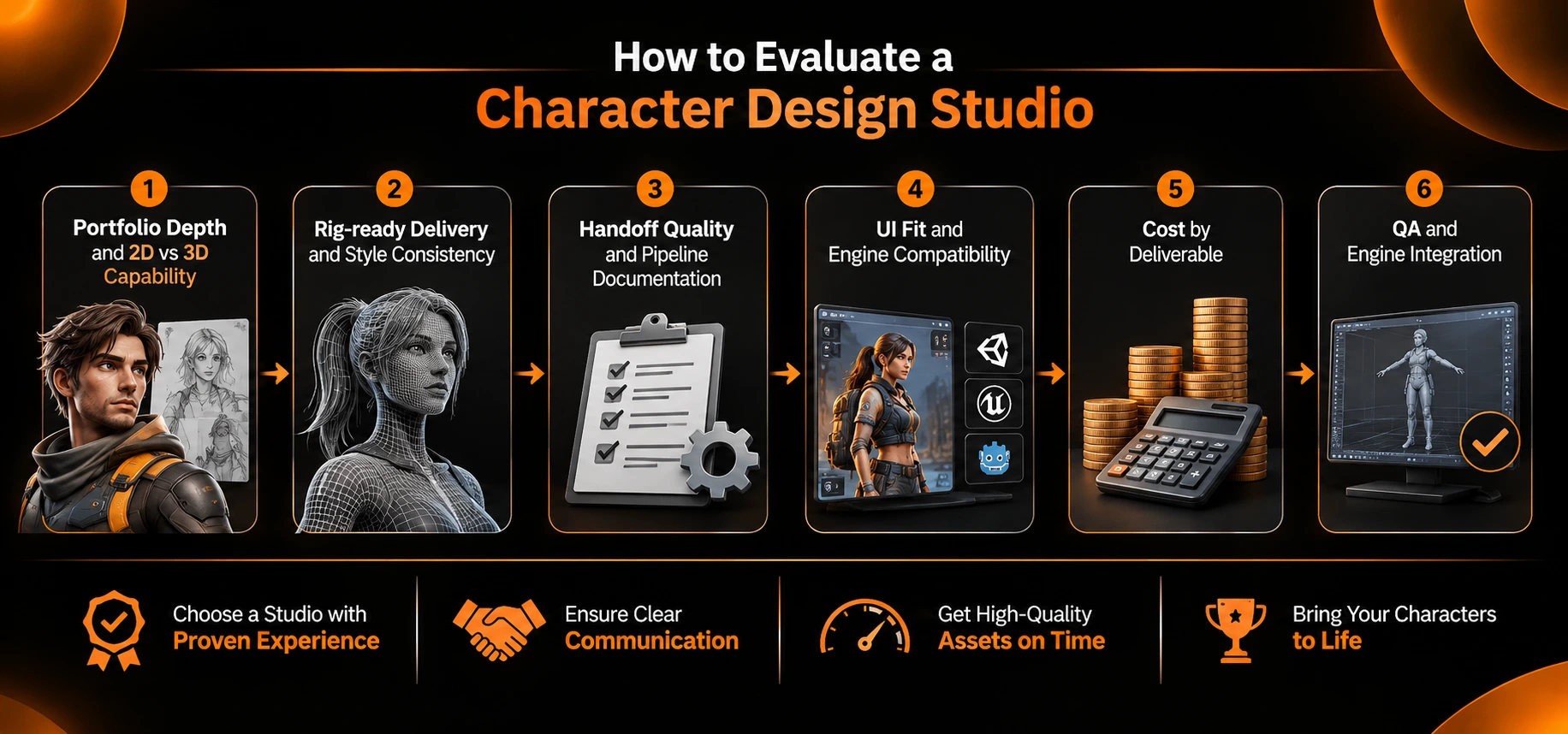
How to Evaluate a Character Design Studio
Read the character design portfolio for range and production proof, not polish. The best benchmark is finished characters inside shipped builds, not isolated renders. Then test each criterion below against your needs.
1. Portfolio depth and 2D vs 3D capability
A studio that paints great heroes may have no rigging pipeline. Find out which discipline is its core, and look for shipped work rather than showpieces.
2. Rig-ready delivery and style consistency
Ask for a sample rig test and confirm topology, edge flow, UVs, and naming standards. Then check whether the studio can hold one look across fifty characters.
3. Handoff quality and pipeline documentation
Request a written character pipeline reference covering formats, naming, and delivery stages. A studio that works from a written spec hands off cleanly. One that improvises each delivery creates gaps that only show up during animation.
4. UI fit and engine compatibility
Characters show up in menus, HUDs, loading screens, and store art, so alignment with UI/UX design decisions saves rework later. Engine fit matters just as much. Assets need to import cleanly, keep their materials, and animate with your rig standard.
5. Cost by deliverable
Compare character design cost by deliverable, not headline rate. A good quote separates concept, modeling, texturing, rigging, and revision rounds, so you can see what each stage costs and what’s left out. Low quotes often skip revisions or technical cleanup, and that’s where budgets slip.
6. QA and engine integration
Ask how deformation, clipping, and LOD behavior get checked. Structured QA services catch these faults far more cheaply before animation starts, and a studio with an internal review step usually returns cleaner files and fewer revision rounds over a long schedule. Ask to see a sample review checklist, because the way a studio tests its own work says a lot about how it will treat yours.
Proven Unity game development experience helps too. It reduces integration surprises and shortens the path from delivery to playable build, whether you target mobile, console, or PC.
Common Mistakes When Hiring Character Design Studios
The most common mistake is trusting a single-style portfolio. A studio that shows ten takes on one look may not adapt to your art direction, and ignoring 2D vs 3D fit makes it worse. Confirm shipped experience with Unreal game development or your own engine before you sign. Assets built to the wrong standards have to be rebuilt, not patched, and the delay usually lands on the animation schedule.
1. Skipping rig-ready and handoff terms
If the contract doesn’t define topology standards, file formats, revision rounds, and IP transfer, disputes surface at integration. Define scope before you request character design services quotes, so every vendor prices the same deliverable. Ask each studio to quote against an identical brief, with polygon targets, texture resolution, and revision rounds, then compare the answers line by line. Include the engine version and the delivery format in that brief too, so nothing is left to assumption.
2. Price-only decisions
The lowest quote for character design outsourcing often excludes revisions, rigging, or engine integration, which come back later as change requests. Broader game art outsourcing decisions should always compare complete deliverables.
Concluding Note
The top character design studios share one trait: their characters work inside a production pipeline, not just on a presentation board. The ten studios profiled here span 2D, 3D, AAA, cinematic, and boutique options, and each has a limitation worth weighing against your project.
Decide whether you need 2D, 3D, or both, then test rig-ready delivery, style consistency, and handoff quality with a small paid pilot. Compare complete deliverables instead of headline rates, and ask for references from similar projects. Treat the first batch as a test of the working relationship as much as the art, and expand only when delivery, communication, and technical quality hold up. Whichever studio you shortlist, put the handoff terms in writing before the first sketch is approved.
Frequently Asked Questions
1. How much does game character design cost?
Commonly cited benchmarks run $150−$750 for a 2D hero, $250+ for stylized 3D, and $1K−$4K for realistic PBR work. Ask for concept, modeling, texturing, rigging, and revisions to be priced separately.
2. What’s the difference between 2D and 3D character design?
2D work produces turnarounds, expression sheets, and layered files for sprite or skeletal pipelines. 3D work produces sculptures, retopologized meshes, PBR textures, and a skeleton ready for the engine.
3. What does rig-ready mean?
The model has clean topology, good edge flow at joints, tidy UVs, and consistent naming. Without that, your technical artists finish the job and the savings disappear.
4. Should I pick a studio that does both 2D and 3D?
Only if both are genuinely core. Few studios do both well, and a strong 2D painter may lack a rigging pipeline.
5. How do I evaluate a character design portfolio?
Look for finished characters inside shipped builds, not isolated renders. Ask for references from similar projects, including what went wrong.
6. What belongs in a character design brief?
Polygon targets, texture resolution, style references, revision rounds, file formats, and delivery stages. Send the same brief to every studio so quotes compare cleanly.
7. How do I prevent style drift across a large batch?
Ask for a style guide and a proof-of-concept batch first. Review the first five to ten deliverables before scaling to the full set.
8. What are the biggest hiring mistakes?
Trusting a single-style portfolio, skipping rig-ready and handoff terms, ignoring 2D vs 3D fit, and choosing on price alone.
9. How do I test a studio before a large project?
Commission a paid pilot of one character or a small batch, and judge rig-ready delivery, consistency, and handoff quality.
10. What engine experience should a studio have?
Shipped assets in your engine, whether Unity, Unreal, or custom. Import behavior, materials, and rig standards differ, and mismatches are expensive to fix.
Get a Cost Estimate for Production-Ready Game Characters