Key Takeaways
- OTT platforms require more than video playback, with transcoding, CDN delivery, DRM protection, and subscription billing forming the core infrastructure.
- OTT MVP development typically costs $35K-$80K, while growth platforms range from $80K-$200K and large-scale builds start above $200K.
- Recurring expenses for CDN delivery, DRM licensing, and maintenance can reach 20–35% of initial development costs annually.
- Effective SVOD billing must manage renewals, failed payments, refunds, subscription changes, and content entitlements across every supported device.
- Choosing between custom, managed, and hybrid OTT platforms depends on launch speed, integration needs, ownership, and long-term total cost.
- A focused MVP, reliable playback, early DRM testing, and phased device expansion help control costs while supporting subscriber retention.
Introduction
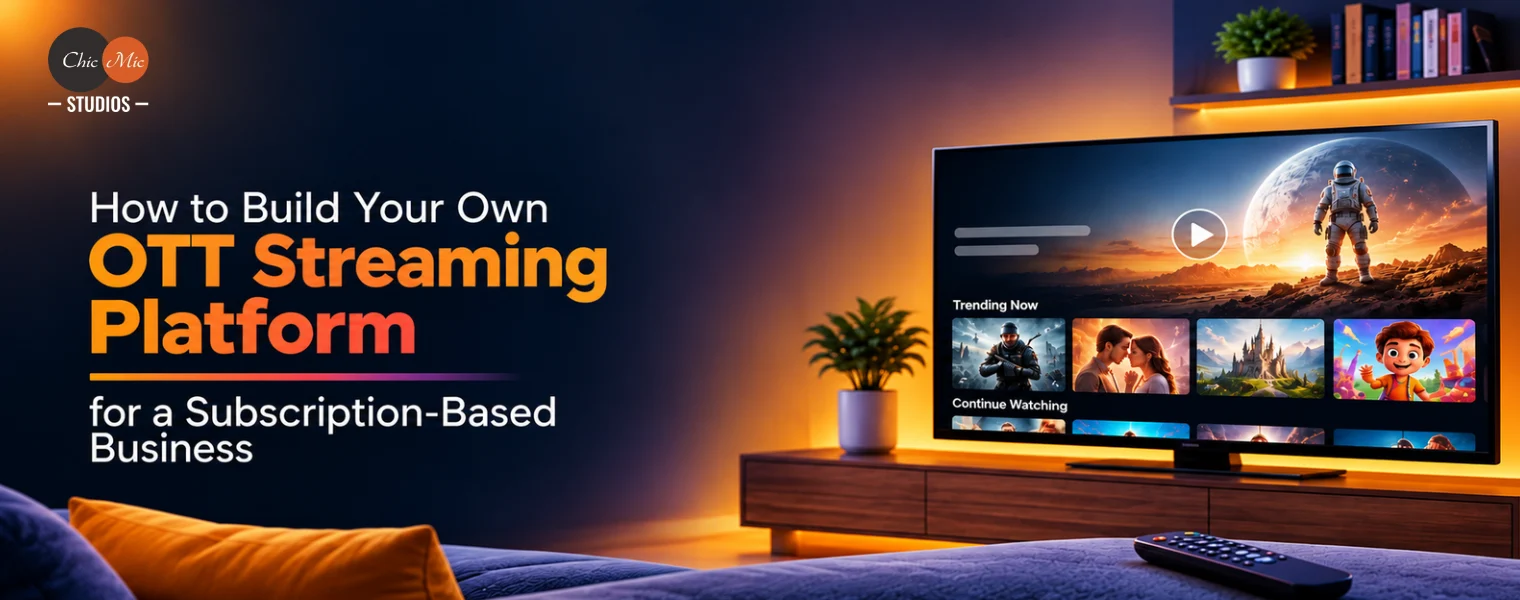
Subscription video isn’t a Netflix-only game anymore. Publishers, coaches, studios and enterprises are launching their own subscription video on demand services, because owning the viewer and the billing relationship is worth more than renting reach from someone else’s platform. The catch? The economics only work if you know what you’re signing up for.
If you want to build OTT streaming mobile app products that people pay for every month, drop the idea of a mobile app with a video screen. You’re running media infrastructure that happens to have an app on top.
This guide walks through the features that matter, the architecture, realistic costs, subscription billing and an honest build-versus-buy comparison, so you can launch without burning through your runway. Whether you’re a media founder, a creator building a paid community or an enterprise weighing OTT platform development, the goal is the same: a service viewers trust to play smoothly, and a business that survives its own infrastructure bills.
Planning to Launch Your Own OTT Streaming Platform?
What Makes an OTT Platform Different From a Mobile App
Most mobile apps are a client talking to a backend. An OTT product is a media supply chain, and the app is just the last step. Technavio projects the global OTT market will grow by about USD 439 billion between 2022 and 2027, which explains why so many new players are piling in. It also means viewers are used to polish. Nobody forgives buffering just because a service is new.
Four infrastructure layers set OTT apart from a standard app:
- Transcoding
- CDN delivery
- DRM content protection
- Subscription billing
A “Netflix clone” app gives you screens, not a business. Skip any of these layers and video buffers, premium content leaks, or renewals fail without anyone noticing. Good OTT app architecture treats each layer as a product in its own right, because a subscription video on demand service lives or dies on how well they work together.
Core Features Every Subscription OTT Platform Needs
Viewers decide within minutes whether your service is worth paying for, so the core OTT platform features have to be dependable before they’re impressive. Five groups cover the foundation:
- Catalog and search
- Video player
- Profiles and devices
- Payments and plans
- Analytics
An MVP needs a browsable catalog, secure playback, one or two subscription plans and basic viewing analytics. Offline downloads, recommendations, parental controls, live events and smart TV apps can wait until retention data tells you they’re worth it. Tie plans to entitlements through SVOD subscription billing from day one, and you’ll avoid painful rework later.
The player deserves extra attention. Dacast’s guide to adaptive bitrate streaming walks through the choices around protocols, bitrates and video players that shape playback quality, so treat the player as a core product component, not a plugin. Think through how it behaves on slow networks, after a resumed session, and when someone switches from phone to TV, before you lock the design.
The Technical Stack: What Powers an OTT Platform
Each layer of the stack solves one problem. Video transcoding turns every upload into several renditions packaged as HLS and MPEG-DASH, which makes adaptive bitrate streaming possible: the player shifts quality as the viewer’s connection changes. A CDN serves those segments from locations close to the viewer, and DRM encrypts them so only paying subscribers can play them.
| Layer |
Typical choice |
Role |
| Transcoding and packaging |
FFmpeg-based or managed cloud encoder, HLS and DASH output |
Builds the bitrate ladder |
| CDN delivery |
Single or multi-CDN with origin shield |
Serves segments near viewers |
| DRM |
Widevine, FairPlay, PlayReady via multi-DRM service |
Encrypts content, issues licenses |
| Player |
ExoPlayer, AVPlayer, Shaka Player |
Plays streams, switches bitrates |
| Backend |
Microservices for catalog, users, entitlements |
Applies business rules |
| Database |
PostgreSQL with Redis cache |
Stores accounts, plans, history |
DRM content protection is the layer teams underestimate most often. Three dominant systems each cover a different slice of the device landscape: Widevine for Android and Chrome, FairPlay for Apple devices, and PlayReady for Windows and many smart TVs. Axinom’s multi-DRM overview maps these vendors to how they’re integrated across OTT services.
OTT Streaming App Development Cost: What You Actually Pay
Quotes for OTT streaming app development cost swing widely between vendors, so be wary of any single number. Here’s a realistic planning range:
| Tier |
Budget |
Typical scope |
| MVP |
$35K-$80K |
VOD catalog, one or two platforms, one plan, basic DRM, analytics |
| Growth |
$80K-$200K |
iOS, Android, web, multi-DRM, several plans, recommendations, admin tools |
| Scale |
$200K+ |
Live streaming, 4K, TV device families, multi-CDN, personalization |
Four drivers move the OTT MVP cost the most: how many platforms you launch on, whether you stream on-demand or live, how strict your DRM requirements are, and how many device families you support. Live streaming typically adds 30–50% to infrastructure cost over on-demand, since it needs real-time transcoding, tighter latency targets and often dedicated encoders. Oxagile’s cost guide lands in a similar place, naming platform count, streaming type, backend architecture, content protection and monetization complexity as the main drivers.
These drivers stack on each other. A live, multi-device service with strict DRM costs far more than the sum of its parts, because testing and operations grow with every combination. Cross-platform frameworks help close the gap: Flutter app development, for example, lets one team ship to iOS and Android from a single codebase, though TV apps and web players still need their own engineering.
The build is only the first invoice. Recurring costs cover CDN delivery, DRM licensing and maintenance, which typically runs 20–35% of the build cost every year. Give CDN spend its own line item, because per-GB pricing climbs with every audience milestone, as this look at CDN egress fees at scale explains. Budget for it before launch, not after your first busy week. A small catalog with a big audience can cost more to deliver than to produce, so model egress from expected viewing hours, not from the number of titles.
Before you sign anything, ask each vendor to price a native route and a cross-platform one, including React Native app development, and to put recurring costs right next to the build quote.
Need a Clear Budget for Your OTT Streaming App?
Subscription Billing and Entitlements: The Hidden Complexity
Charging a card once is easy. Running SVOD subscription billing is not. The lifecycle covers trials, upgrades and downgrades, renewals, proration, failed payments and retries, cancellations, refunds and tax. Every one of those states also has to update entitlements, the rules that decide who can watch what, on how many devices, at which quality.
Failed payments quietly drain revenue, so build retry and grace-period logic early. Device concurrency limits matter just as much, because shared passwords erode revenue as surely as churn does.
App stores add another layer. In-app subscriptions bought through Apple or Google typically carry a 15–30% fee, which shapes both your pricing and your unit economics. Web checkout can sidestep those fees in some cases, but store rules differ by region and change often, so confirm current policies before you design your funnel. Whichever route you take, keep one source of truth for subscription status, so a purchase made on the web unlocks the same content on every device.
Build vs Buy: When Custom Makes Sense
Build vs buy OTT is a genuine strategic question, not a sales pitch for custom development. A managed platform can get you live in weeks, on infrastructure someone else runs. A custom platform gives you control over the experience, your data, integrations and revenue share, at a higher upfront cost and with ongoing engineering responsibility.
Total cost of ownership is the fair way to compare them. 24i’s build-versus-buy guide points out that initial development rarely reflects the long-term investment once you count maintenance, infrastructure, security, device support and operations, and that buying often wins on TCO. For early-stage services, that’s frequently true.
Buy when you’re validating demand, have a thin catalog or need to launch fast. Build when your experience is a real differentiator, you need deep integrations, or managed-platform fees would outgrow the cost of your own team. For many teams, a hybrid is the most practical path: license transcoding, DRM and CDN as services, then build the apps and billing logic around them.
The Development Process Step by Step
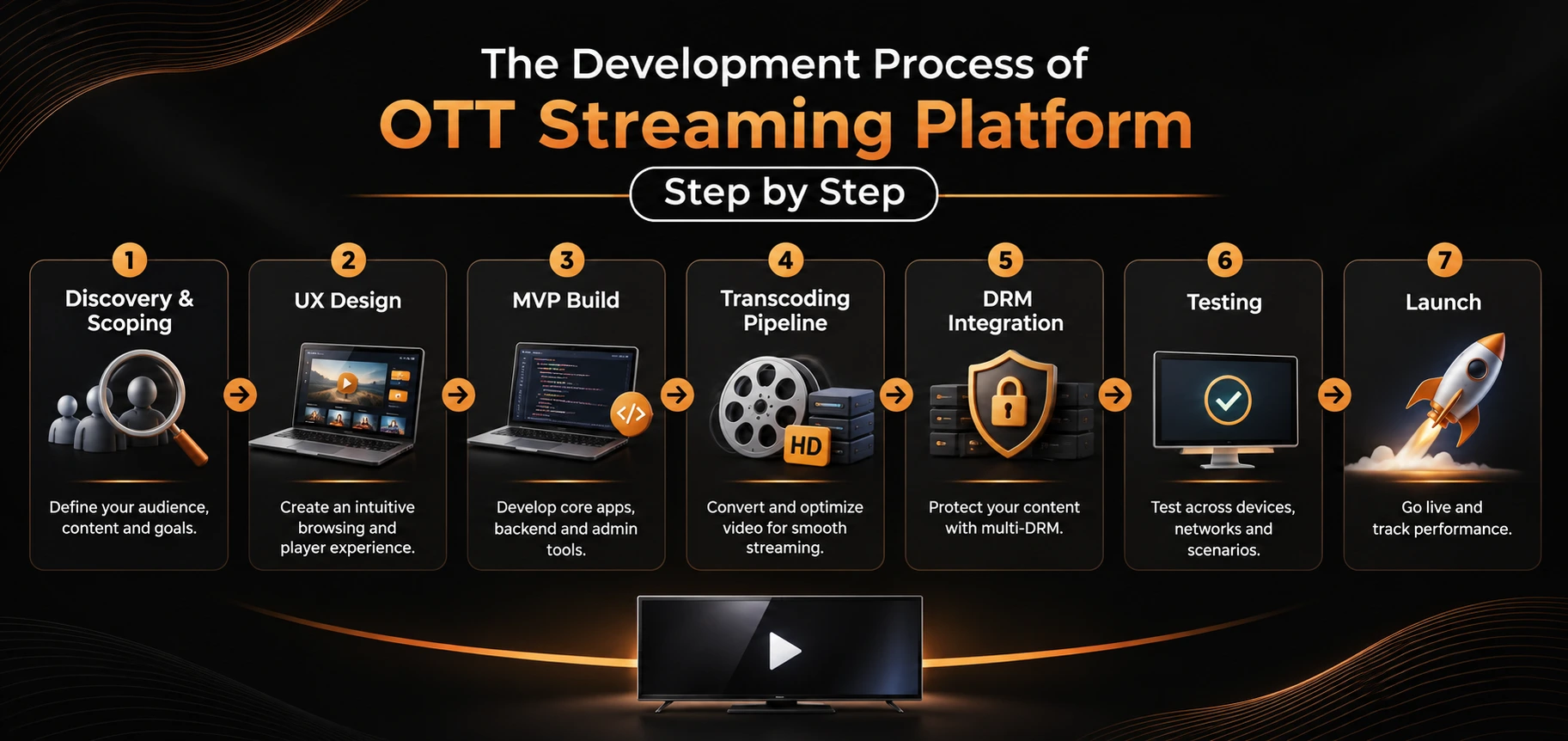
A structured, step-by-step approach to building a successful OTT streaming platform, covering everything from initial planning and user experience design to development, video delivery, security, testing, and launch.
1. Discovery and Scoping
Pin down your audience, content model, monetization and target devices. Lock the MVP scope here, because every extra platform or live feature multiplies cost later.
2. UX Design
Browsing, onboarding and the player screen decide whether people stay. Strong UI UX design for streaming covers catalog discovery, plan selection and TV-friendly navigation before anyone writes code. Prototype the player screen first and put it in front of real viewers, because a clumsy playback experience is the fastest way to lose a paying subscriber.
3. MVP Build
Build the apps, backend and admin tools in sprints. If most of your paying viewers are on iPhones, start with iOS app development, where AVPlayer and FairPlay give you a well-worn path to protected playback. Keep backend and billing logic platform-neutral from the start, so entitlements, plans and watch history behave the same on every screen you add later, and write the rules down once so each new client inherits them. When web and smart TV follow, a cross-platform app development approach can share logic and cut duplicated effort.
4. Transcoding Pipeline
Set up ingest, transcoding and packaging into HLS and DASH with a sensible bitrate ladder, then add thumbnails, subtitles and audio tracks. Test on poor networks early, because encoding choices drive both quality and CDN spend.
5. DRM Integration
Wire in multi-DRM and license servers, then check protected playback on every target device. Android app development needs particular care here, since Widevine security levels and manufacturer quirks decide which resolutions each phone can play. Agree on a device test matrix before development wraps up, not during launch week.
6. Testing
Test playback, DRM, billing and entitlements across devices, networks and failure cases. Dedicated QA services catch the problems that only show up in the real world, like expired licenses, interrupted payments and device switching.
7. Launch
Launch in stages and watch startup time, rebuffering, playback failures and churn. Get store submissions, privacy disclosures and a post-launch roadmap ready before release day.
How to Choose an OTT App Development Partner
Look for proof, not promises. A credible mobile app development company should show you shipped streaming work and explain how it handled transcoding, CDN choices, DRM integration and billing, not just app screens. Ask for references and for analytics from earlier launches.
Favor a team that offers OTT streaming app development services across strategy, design, engineering, QA and post-launch support, because gaps between vendors turn into gaps in your playback. If you’d like to talk through mobile app development services for a streaming product, ChicMic’s team can help scope a first release. Whoever you talk to, ask how they’d split your budget between video infrastructure, app development and billing, and how they’d handle post-launch monitoring, license renewals and device updates once real traffic arrives.
Finally, compare proposals line by line. An app development cost guide can show you how scope, platforms and integrations shape any estimate, and help you spot what a low quote leaves out, such as DRM, testing or support.
Concluding Note
A subscription OTT business wins on infrastructure, billing discipline and honest scoping, not on screens alone. Plan for transcoding, CDN delivery, DRM and entitlements from day one, budget for recurring costs of 20–35% of the build each year, and choose between custom and managed platforms on total cost of ownership.
Start with a focused MVP, prove that people stay, then add devices and features as the data supports them. Treat every new platform, live feature or DRM requirement as a deliberate budget decision, not a default, and revisit the plan after each release.
If you’re ready to build OTT streaming app capabilities with a team that understands both mobile engineering and streaming infrastructure, ChicMic Studios can help you shape the right first release and a realistic budget.
Frequently Asked Questions
1. How much does it cost to build an OTT streaming platform?
An MVP with a VOD catalog and basic DRM runs $35K-$80K. A growth-stage platform with iOS, Android, web and multi-DRM costs $80K-$200K. Scale platforms with live streaming, 4K and TV device families start at $200K+. None of that includes recurring CDN, DRM and maintenance costs.
2. How long does it take to build an OTT platform?
An MVP takes 3–5 months. Growth-stage platforms take 6–9 months, and scale platforms with live streaming and multi-device support take 9–12 months. DRM integration and device testing are the most common schedule risks.
3. Should I build or buy an OTT platform?
Buy if you’re validating demand, launching fast or running a thin catalog. Build if the experience is a differentiator, deep integrations matter, or managed-platform fees would outgrow your own team’s cost. A hybrid, where you license transcoding, DRM and CDN but build the apps and billing, is often the most practical path.
4. What are the four infrastructure layers of an OTT platform?
Transcoding converts uploads into multiple renditions, CDN delivery serves segments near viewers, DRM encrypts content and controls playback, and subscription billing handles plans, renewals and entitlements. Without all four, video buffers, content leaks or renewals fail.
5. Do I need DRM for my OTT platform?
Yes, if you stream licensed or premium content. DRM protects against piracy and usually satisfies content licensing requirements. Widevine (Android and Chrome), FairPlay (Apple) and PlayReady (Windows and smart TVs) are the three dominant systems, typically integrated through a multi-DRM service.
6. How much do recurring OTT costs run?
Plan on 20–35% of the build cost each year for CDN delivery, DRM licensing and maintenance. CDN egress grows with audience size, so model it from expected viewing hours, not catalog size. DRM licensing is typically charged per title or per device.
7. What is SVOD subscription billing?
It’s the full lifecycle of subscription video on demand revenue: trials, upgrades, downgrades, renewals, prorations, failed payments, retries, cancellations, refunds and tax. Each state has to update entitlements, meaning who can watch what, on how many devices, at which quality. Failed payments and shared passwords erode revenue if you don’t handle them carefully.
8. What app store fees apply to OTT subscriptions?
Apple and Google typically charge 15–30% on in-app subscriptions. Web checkout can avoid those fees in some cases, but policies differ by region and change often. Keep one source of truth for subscription status so a web purchase unlocks content on every device.
9. Which tech stack should I use for an OTT platform?
Think FFmpeg-based or managed transcoding for HLS and DASH packaging, multi-CDN with origin shield, multi-DRM (Widevine, FairPlay, PlayReady), ExoPlayer, AVPlayer or Shaka Player, a microservices backend, and PostgreSQL with a Redis cache. Flutter or React Native can share app logic across iOS and Android, but TV and web still need dedicated engineering.
10. How do I choose an OTT app development partner?
Ask for shipped streaming work, not just app screens, and request references and analytics from earlier launches. Confirm they understand transcoding, CDN choices, DRM and subscription billing, not only mobile engineering. Compare proposals line by line to spot what a low quote leaves out, such as DRM, testing or support.
Ready to Build an OTT Platform That Can Scale?