Key Takeaways
- A Practo-style telemedicine platform combines patient, doctor, and admin apps through one shared backend and secure API layer.
- Telemedicine MVP development costs $40K-$70K, while full-featured platforms with FHIR and AI can exceed $250K.
- Video infrastructure, reliable appointment scheduling, and secure clinical records are critical components that directly affect patient experience and platform reliability.
- HIPAA, India’s DPDP Act, and Telemedicine Practice Guidelines shape architecture, vendor selection, and compliance budgets from the first development sprint.
- Recurring expenses for video usage, cloud hosting, messaging, payment processing, and maintenance can add 18–22% of build costs annually.
- Successful telemedicine platforms require regulated healthcare delivery experience, reliable integrations, clinical workflow expertise, and clear post-launch support.
Introduction
Telemedicine has gone from pandemic stopgap to a normal way of seeing a doctor, and India shows it better than most markets. Practo now connects more than 50 million patients with over 500K doctors, and it reported approximately $28 million in FY25 revenue.
No wonder founders, clinic operators, and enterprises keep asking how to build a telemedicine healthcare app like Practo without repeating earlier platforms’ mistakes. Here’s the honest answer: the app itself is the easy part.
The hard parts are a two-sided marketplace, a regulated clinical workflow, and video that doesn’t fall apart on a weak mobile network. This guide covers features, architecture, cost, and compliance in the order real projects tend to face them.
What Makes a Practo-Style Telemedicine Platform Different
Practo didn’t grow because of a better video call. It grew by solving three linked problems at once: matching patients with doctors they trust, supporting everything that happens before and after a consult, and keeping health data defensible in front of regulators. If you want to scope your own build realistically, start by seeing how those three layers depend on each other.
1. Three Layers Separate a Booking Tool From a Real Care Platform
Practo isn’t a video-call app. It’s a two-sided marketplace, sitting on a clinical workflow, wrapped in compliance. Each layer adds work that a simple booking tool never has to face.
| Layer |
What It Requires |
Why It Matters |
| Marketplace |
Doctor discovery, verification, ratings, dispute handling |
Both sides must trust the platform before they join |
| Clinical workflow |
Scheduling, video consults, e-prescriptions, records |
Doctors judge the platform by time saved per consult |
| Compliance |
HIPAA, DPDP, Telemedicine Practice Guidelines |
Shapes architecture from day one, not launch week |
2. Why the Business Model Matters as Much as the Code
Practo reports over 50 million patients and a gross merchandise value near $420 million. A good share of its revenue comes from clinic software and services, so the business model carries as much weight as the code.
Copying the interface without the supply side rarely works. Doctors join platforms that bring patients, and patients join platforms that list doctors they trust. Plan to seed both sides in one city or specialty first.
3. Decide Which Side You Are Solving For
If you plan to build a telemedicine app, pick your side early. If you want to build an app for telemedicine inside an existing clinic network, you can skip public discovery and focus on workflow.
A Practo clone app aimed at open discovery needs both sides, plus doctor verification, ratings, and dispute handling. Every extra layer stretches your timeline and widens your compliance exposure.
Ready to Turn Your Telemedicine Idea Into Reality?
Essential Features: Patient, Doctor, and Admin Apps
Telemedicine features aren’t a list of screens. They’re the daily routines of three very different users, each wanting something different from the product. Below, we walk through what each app has to do, and flag the details that quietly decide whether people keep using the platform after the first week or abandon it. Treat each app as its own product with its own success metric.
1. Three Apps Share One Backend, and Each Needs Its Own Workflow
A patient app, a doctor app, and an admin panel run on one API layer. That keeps data consistent and lets you ship each surface on its own schedule.
| App |
Core Features |
Critical Detail |
| Patient app |
Search, booking, video, records, payments |
Slot accuracy decides trust within the first week |
| Doctor app |
Calendar, consultation, prescriptions, earnings |
E-prescription templates speed up each consult |
| Admin panel |
Verification, analytics, payouts, disputes |
Operations succeed or fail here, not in the app |
2. Why Slot Accuracy Is a Core Feature
A doctor appointment booking app lives or dies on slot accuracy. One double-booking in the first week and trust takes a hit, so build availability as a core feature, not a calendar widget.
Reminders, rescheduling, and no-show handling belong in release one. Add e-prescription templates and secure follow-up chat early too, because doctors judge the platform by how little time it adds to each consultation.
3. The Admin Panel Is Where Operations Succeed or Fail
Doctor verification, refund rules, complaint queues, and payout reports are what keep a marketplace trustworthy. Teams underestimate them during scoping, and they’re expensive to bolt on later.
Feature scope drives budget, too. Arkenea’s published benchmarks put telemedicine MVPs with video visits, scheduling, and secure chat at $70K to $120K. Full platforms with e-prescribing and EHR integration run $120K to $170K.
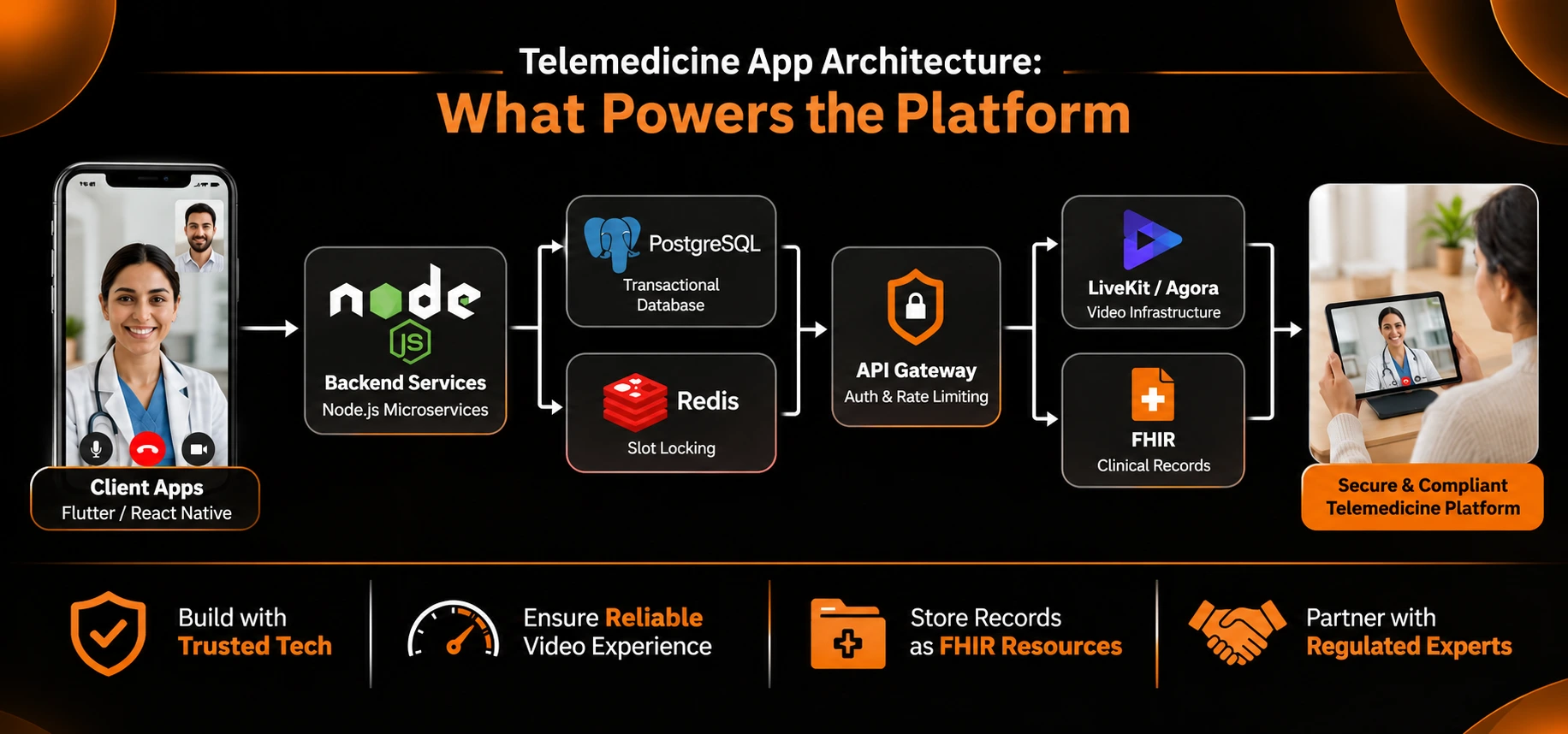
Telemedicine App Architecture: What Powers the Platform
In telemedicine, architecture choices are really compliance choices in disguise. The database you pick, the video provider you plug in, and how you store clinical records all decide how much compliance work lands on you later. Here’s the stack we’d reach for, the trade-offs behind each piece, and where the risk tends to hide. Get these right early and later changes stay cheap.
1. Pick Proven Components for Every Part That Touches Patient Data
A sound telemedicine app architecture starts at the client. Flutter app development lets one codebase serve both the patient and doctor apps, which speeds delivery and keeps the interface consistent.
If your team is strong in JavaScript, React Native app development is a fair alternative. Either works as long as your video SDK ships a maintained plugin for it.
2. The Full Stack at a Glance
| Layer |
Technology |
Purpose |
| Client apps |
Flutter or React Native |
Shared codebase for patient and doctor apps |
| Backend services |
Node.js microservices |
Independent scaling for booking, payments, notifications |
| Transactional database |
PostgreSQL |
Booking integrity and payment records |
| Slot locking |
Redis |
Prevents double-booking on concurrent requests |
| API gateway |
Token auth, rate limiting |
Security and traffic control |
| Video infrastructure |
LiveKit or Agora |
WebRTC consults with recording support |
| Clinical records |
FHIR resources |
Interoperability with hospital systems |
3. Video Is the Costliest Dependency
LiveKit and Agora both offer WebRTC infrastructure with mobile SDKs. LiveKit’s official documentation explains rooms, tracks, and recording in plain terms.
Whichever you pick, test on 3G-grade connections, because weak networks decide whether your video consultation infrastructure succeeds. Build an audio-only fallback from the start.
Monitor call quality, join failures, and reconnect rates so your team spots problems before patients complain. And store clinical data as FHIR resources from day one. Retrofitting it later hurts.
4. Choose a Partner Who Has Shipped Regulated Apps
Pair this stack with a mobile app development company that has shipped regulated apps and can defend each architecture decision. The principle is simple: patient, doctor, and admin workflows belong on one shared, secure backend, not bolted onto a generic app template.
Telemedicine App Development Cost: What You Actually Pay
Cost comes down to scope, how deep your compliance work goes, and how many apps you build. Below, you’ll see how the tiers compare, what individual modules cost, and how spending shifts as the platform matures. Use the ranges for planning, then pressure-test them with a real estimate once your feature list is settled. Small scope changes early can shift the total noticeably.
1. Budget for the Build and for the First Year of Running It
Telemedicine App Development cost depends more on scope than on any single technology choice. A focused telemedicine MVP cost sits between $40K and $70K, while a marketplace with three apps needs more room to grow.
| Tier |
Budget (USD) |
Timeline |
Typical Scope |
| MVP |
$40K-$70K |
3–5 months |
Booking, video, payments, basic records |
| Mid-tier |
$70K-$150K |
5–8 months |
Three apps, e-prescriptions, records |
| Full platform |
$150K-$250+ |
9+ months |
FHIR, analytics, AI triage, multi-language |
2. Module-Level Budget Breakdown
For early budgeting, the core components break down roughly like this:
- Doctor directory: $1,900-$3,900
- Booking: $2,900-$5,800
- Video: $3,100-$6,300
- Prescriptions: $1,900-$3,900
- Records: $2,900-$5,800
- Payments: $1,900-$3,900
Treat these as starting points. Team location, design depth, and integrations all move the final number. Add the modules up and it’s clear why a lean MVP postpones reviews, loyalty credits, and multi-language support until demand is proven.
3. Where the Money Goes Over Time
Early spend goes to design, backend, and video integration. Later spend shifts toward compliance audits, new specialties, and scaling infrastructure.
Recurring costs catch founders off guard. Plan for video minutes, SMS and email, cloud hosting, payment gateway fees, and maintenance at roughly 18–22% of the build cost each year.
Planning Your Telemedicine App Budget?
HIPAA and Data Protection: The Non-Negotiable Layer
Compliance isn’t a checklist you tick off at launch. It’s a constraint on the architecture itself, shaping encryption, access control, consent capture, and vendor contracts from the first sprint. This section covers what each region requires, how it affects your budget, and why your choice of vendors matters more than most teams expect. Building it in from the start costs far less than retrofitting.
1. Compliance Shapes Architecture, So Design for It Before the First Sprint
HIPAA compliance telemedicine projects need encryption at rest and in transit, role-based access control, audit logs, patient consent capture, and a Business Associate Agreement with every vendor that touches protected data. The HHS HIPAA guidance lays out the Privacy and Security Rules in detail.
2. Requirements by Region
| Region |
Framework |
Core Requirements |
| United States |
HIPAA Privacy and Security Rules |
Encryption, access control, audit logs, consent, BAAs |
| India |
Telemedicine Practice Guidelines |
Who may consult, prescribe, and keep records |
| India |
DPDP Act |
Consent, purpose limitation, breach notification |
If you serve patients in both regions, build to the stricter standard. Compliance affects budget too: expect HIPAA requirements to add roughly 15–25% to development cost, mostly through security engineering, documentation, and audits.
3. Vendor Choices Carry Compliance Weight
Your video provider, SMS gateway, cloud host, and analytics tools all touch regulated data in some way. Read each contract, confirm data residency, and document who can access what.
FHIR integration telemedicine work belongs in the same plan, since standardized records make consent, export, and audit trails easier to build. Have counsel validate your final obligations before launch.
The Development Process Step by Step
The build follows a fairly predictable sequence, but every stage carries risks a generic app project never meets. Here are the seven phases, with the platform decisions and testing priorities that deserve the most attention at each one. Skipping or rushing any of them usually shows up later as delays, rework, or compliance headaches. Each stage hands clean inputs to the next.
1. Seven Stages Keep Scope, Compliance, and Quality Under Control
| Stage |
Key Activities |
Why It Matters |
| 1. Discovery |
User roles, regulatory scope, integrations |
Prevents scope creep later |
| 2. UX design |
Booking flows, video controls, accessibility |
Reduces drop-off for anxious or older patients |
| 3. MVP build |
Booking, video, payments, basic records |
Proves demand before full investment |
| 4. Backend |
APIs, slot logic, notifications, security |
Runs in parallel with frontend work |
| 5. Video integration |
WebRTC, network testing, audio fallback |
Weak networks decide patient retention |
| 6. Security review |
Penetration tests, token handling, encryption |
Catches flaws before launch |
| 7. Testing and launch |
Functional, load, device, and compliance testing |
Phased release reduces risk |
2. Design Comes First
Discovery pins down user roles, regulatory scope, and integrations. Then put real effort into UI/UX design, because patients are often anxious, older, or on low-end phones. Clear booking flows and accessible video controls cut drop-off more than any extra feature.
3. Platform Choices Shape the Development Stage
Build the MVP around booking, video, payments, and basic records. Backend work runs alongside it: APIs, slot logic, notification services, and security controls.
Native iOS app development unlocks CallKit, so incoming consults ring like phone calls and patients rarely miss them. Cross-platform frameworks cover most needs, but telemedicine pushes device features harder than a typical app.
4. Android Needs Its Own Attention
Battery optimization and background notification limits vary by manufacturer, which is where Android app development expertise earns its keep. A missed notification is a missed consult, and that costs you revenue and trust at the same time.
Test on mid-range phones from several manufacturers, not just flagships. Plenty of patients in tier-two and tier-three cities use budget hardware with aggressive battery management.
5. Testing Deserves Its Own Budget
Dedicated QA services cover functional, load, security, and device testing before launch. Release in phases, then watch consult completion, video failure, and payment success rates.
When you connect to hospital systems, use the official HL7 FHIR specification as your reference for resource design.
How to Choose a Telemedicine App Development Partner
Picking a partner here is risk management, not shopping. The right team has shipped regulated healthcare products, can explain every architecture choice, and raises compliance concerns before you do. This section covers what to look for, what to ask, and where the gap between a strong partner and a merely cheap one tends to show up. A few pointed questions will tell you most of what you need.
Evidence of Regulated Delivery Matters More Than a Polished Pitch
Ask for proof of healthcare work, not just general apps. Request architecture walk-throughs instead of slide decks, and ask how the team handled consent, audit logs, and data residency on past projects.
1. AI Features Need Clinical Review
AI development can add symptom intake, triage summaries, and note drafting, but these features need clinical review and clear guardrails.
A partner who brings up those limits unprompted is usually worth keeping. Any AI feature that touches clinical decisions should be validated by qualified clinicians before launch, not just tested by engineers.
2. Check Video Experience Directly
A capable partner can explain TURN servers, adaptive bitrate, and audio fallback, because those decide call quality on India’s mixed networks. Ask who owns post-launch monitoring and what the support agreement actually covers.
3. Compare Answers on Compliance and Cost
When you’re ready to shortlist, share your scope with a team offering mobile app development services and compare their answers on compliance and cost. A paid discovery sprint is a low-risk way to test a partner before you commit to the full build.
4. Agree on Ownership Early
Source code, cloud accounts, and documentation should belong to you. The contract should spell out response times for production incidents. Clear terms now save painful negotiations after launch.
Concluding Note
Building a telemedicine app like Practo is a product, compliance, and infrastructure project all at once. Start with a focused MVP, choose proven architecture, and budget for HIPAA and DPDP from the first sprint.
Expect $40K-$70K to validate the idea, then plan recurring costs for video, messaging, cloud hosting, and maintenance. The platforms that last earn clinical trust before they chase scale.
Doctors stay when workflows save them time, and patients return when booking, video, and records just work. When you’re ready to scope your build, work with a team that has delivered regulated healthcare products, can show its architecture decisions, and will stay accountable after launch.
Frequently Asked Questions
1. How much does it cost to build a telemedicine app like Practo?
A focused MVP with booking, video, and basic records costs $40K-$70K over 3–5 months. A mid-tier platform with three apps and e-prescriptions runs $70K-$150. A full platform with FHIR integration, analytics, and AI triage starts at $150K and can pass $250K.
2. How long does telemedicine app development take?
MVPs: 3-5 months; Mid-sized apps: 5-8 months. Full platforms with multi-language, advanced compliance, and AI take 9+ months. That’s a typical schedule risk for video and compliance review.
3. What features does a Practo-style app need?
Three apps on one backend: a patient app (search, booking, video, records, payments), a doctor app (calendar, consultation, prescriptions, earnings), and an admin panel (verification, analytics, payouts). Slot accuracy and reminders are core, not optional extras.
4. Does telemedicine app development require HIPAA compliance?
Yes, if you handle US patients and/or protected health information on behalf of covered entities. HIPAA mandates encryption, control of access, audit trails, consent, and Business Associate Agreements with vendors. In India, there are the Telemedicine Practice Guidelines and DPDP Act. If you serve both, design to the higher standard.
5. How much does HIPAA compliance add to development cost?
Security engineering, documentation, and audits add 15-25% on top of the base build. And it’s not a one-time line item: $30K-$120K a year to maintain risk assessments, policy reviews, and vendor management.
Ready to Build a Telemedicine App Like Practo?