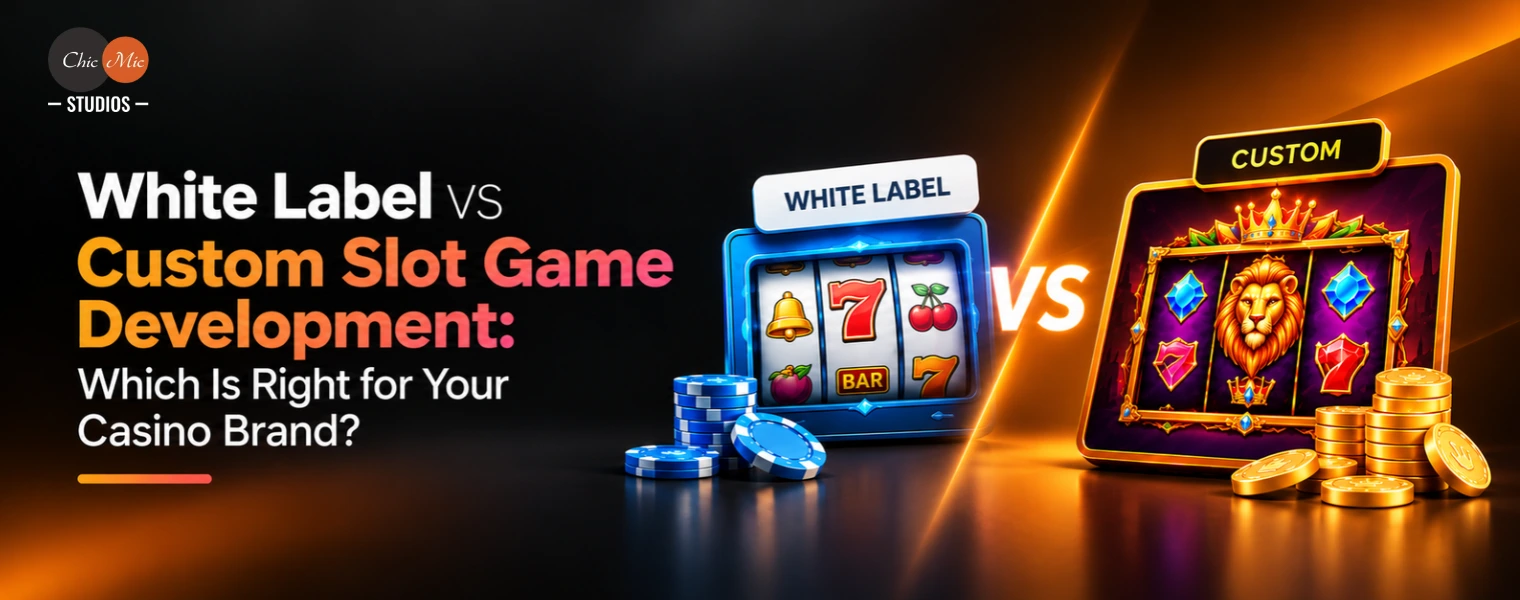
White Label vs Custom Slot Game Development: Which Is Right for Your Casino Brand?
Key Takeaways
- White label launches fast. Lower upfront cost, but shared math and ongoing revenue share.
- Custom slot game development costs more. Higher upfront, longer timeline, but exclusive IP and full margin.
- Revenue share adds up. At $200K/month NGR, a 20% share costs $40K monthly.
- Breakeven depends on your NGR volume. Below the threshold, white label stay cheaper for years.
- Hybrid reduces risk. Launch white label, then build custom once demand is proven.
- Certification is required either way. The provider handles it for white label; custom needs per-title testing.
Introduction
Sooner or later, every casino operator has to answer the same question: do we license finished games from a provider, or build titles that only we own? The answer affects how fast you launch, how much margin you keep, and whether your lobby looks like anyone else’s. This guide to White Label vs Custom Slot Game Development lays out both options honestly, so you can pick the one that suits your stage and strategy.
White label gets you live quickly and costs less upfront, but you share math models and revenue. Custom costs more and takes longer, but the games are yours alone and the margin stays with you. A brand testing a new market has very different needs from an established operator with steady traffic.
We’ll walk through cost, control and differentiation, work out the breakeven math, cover tech and certification, and look at the hybrid route many operators take. By the end, you should know which model fits your next twelve months and what to ask a development partner before you sign anything.
Planning to Launch Your Own Slot Game for Your Casino Brand?
What Is White Label Slot Game Development?
White label slot game development means a provider designs, builds and certifies a game, and you put your own branding on it. You get a finished product with your logo, some theme tweaks and your lobby placement, while the provider holds on to the engine and the math model. The same white label slot games often run in dozens of casinos at once, with identical mechanics and payout behavior.
The upsides are practical. You can launch within weeks, the upfront cost is low, and compliance and certification are usually sorted before you sign. It also helps that the market is big: Mordor Intelligence puts online gambling at roughly $100 billion and expects double-digit annual growth.
The downsides are just as real. Because the math models are shared, players can find the same game on a rival site, and your differentiation rarely goes beyond surface branding. Most deals also come with a revenue share that grows as your traffic does.
White label suits operators who are validating a new market, working with a tight budget, or filling gaps in an existing lobby. It also works for teams with no in-house game design or math talent, since white label slot game software arrives tested and ready to integrate. Just make sure the catalog is deep enough that your lobby doesn’t feel like a template.
What Is Custom Slot Game Development?
Custom slot game development means building a title from scratch around your brand: the math model, art, sound, bonus features and the whole player journey. Nothing is shared, so the game lives only in your lobby. Custom slot games can feature your mascot, plug into your loyalty program, and run at the volatility your players actually enjoy.
The big wins are exclusivity and margin control. When you commission the IP, there’s typically no ongoing revenue share, and exclusive titles give players a reason to pick you over a lookalike. Interviews in iGaming Future describe exclusive slots as a growing way for operators to break out of interchangeable lobbies.
The costs are higher upfront spend, timelines measured in months instead of weeks, and a heavier certification load for every new title. Branded slot game development also needs math, art and engineering talent that few operators keep in-house. That’s why the right call depends on your stage, not just your ambition.
Custom makes sense if you have steady traffic, a brand people recognize, and a content roadmap that runs past a single release. It also fits markets where exclusive content helps with promotions and retention. If players already know your name, a game built around it will do more for you than a generic reskin.
Cost Comparison: Upfront vs Lifetime
Slot game development cost looks very different depending on how far ahead you look. A white label reskin typically runs $10K-$40K upfront, plus a revenue share of 10–25%. Custom slot game development cost starts around $40K and can pass $120K per original title, with no revenue share afterward.
| Factor |
White Label |
Custom |
| Upfront cost |
$10K-$40K reskin |
$40K-$120K+ per title |
| Revenue share |
10–25% |
None |
| Time to launch |
Weeks |
Months |
| Exclusivity |
Shared catalog |
Exclusive titles |
| Math model |
Provider-owned |
Tailored to your brand |
| Certification |
Usually provider-handled |
Required per title |
Use these as planning ranges, not quotes. Some sources report white label shares of 15–30%, and this pricing breakdown shows that deals usually combine setup fees, monthly fees and a revenue share. That share can be applied to gross gaming revenue (GGR) or net gaming revenue (NGR), and the difference can move your effective cost by several points, so get it in writing.
The headline numbers also leave out smaller items. Localization, certification for each jurisdiction, art revisions and promo assets can add up on either side. White label deals may carry monthly minimums, and custom projects need a maintenance budget for patches, new features and seasonal updates.
Want to Compare White Label vs Custom Slot Game Development Costs?
The Breakeven Math: When Custom Beats White Label
Revenue share is easy to ignore until you add it up, which is why breakeven math matters more than the sticker price. NGR is gross gaming revenue minus player bonuses and promotions, roughly what you keep before platform costs. At $200K a month in NGR and a 20% share, white label costs $40K every month, or $480K a year. A custom build with a $250K higher upfront gap pays for itself in about six months (250K ÷ $40K = 6.25), a little longer once maintenance and certification are included.
Volume is what decides it. At $50K a month, the same 20% share costs $10K, and that $250K gap takes roughly 25 months to recover. Even if you negotiate down to 10%, a share Blask’s explainer cites as common, the $200K example still needs about 12.5 months. Below the threshold, white label stays cheaper for years.
A simple way to test your own numbers is to compare three-year totals. Add up the revenue share you expect to pay over 36 months at realistic NGR, then set it against what it would cost to build and maintain your own titles over the same period. If the first number is clearly bigger, custom has a positive return. If they’re close, a hybrid approach usually lowers the risk.
Once you’re past the threshold, custom pulls further ahead every month. A slot game development company can model your own traffic forecast, and experienced iGaming software development teams will also price in certification, hosting and updates so the comparison is fair. Keep in mind that the $250K gap usually covers a small portfolio of original titles, not one game.
Control, Differentiation, and Brand Ownership
With white label, you get a shared catalog and a limited brand. Your competitors can license the same titles, so your lobby may feel familiar to anyone who browses more than one site. Most of your brand expression comes down to skins and promotions.
Custom turns that around. Exclusive titles can feature your mascot, tie into loyalty tiers, and use math models tuned with your own player data, like volatility and bonus frequency. A thoughtful UI/UX design process makes the game feel like part of your brand instead of something bolted on, from the reel animations to the bonus-round flow.
It shows up in marketing too. Exclusive titles give your CRM team something new to announce, your affiliates something distinctive to promote, and your tournaments a signature game to build around. With a shared catalog, competitors have the same hooks, and the contest drifts back to bonuses and price.
Ownership goes beyond looks. Check who owns player behavior data and game analytics under each contract, because that data drives your retention decisions. Custom also lets you set performance budgets for load time and animation weight, and Mozilla’s canvas guidance shows how techniques like offscreen pre-rendering keep graphics smooth.
Tech Stack and Certification
Both models rest on the same technical foundations and the same compliance rules. What changes is who does the work. Mobile-first delivery, fast loading and clean integration with your casino platform matter either way.
1. HTML5 for Distribution
HTML5 slot game development is still the standard for reach, because one codebase runs in mobile and desktop browsers with no plugins or app-store approval. That’s why white label catalogs are almost all HTML5. Custom builds can take the same route and still add distinctive animation and sound within performance limits.
2. Unity for Premium Visuals
If your brand leans on cinematic visuals, Unity game development gives you richer 3D effects, particle systems and character animation. The trade-off is bigger bundles and more work on web delivery. Many operators save Unity for flagship exclusives and use lighter HTML5 titles everywhere else.
3. RNG Certification and Testing
Both models need certified random number generation and verified return-to-player behavior before launch. With white label, the provider usually holds the certificates, while with custom, each new title needs its own independent test. Labs such as eCOGRA test RNG algorithms statistically and check how well they resist prediction. For the formal requirements around RNG and system integrity, see the GLI-19 standard. Solid QA services also catch functional, device and performance bugs before the lab ever sees the build.
The Hybrid Approach: White Label Now, Custom Later
The most common path is hybrid: launch with white label to prove demand, then build custom exclusives once traffic settles. White label content shows you which themes, mechanics and volatility levels your players actually prefer. That data takes the risk out of later investments, which is why this sequence is widely treated as industry best practice.
Moving into casino game development on your own terms is easier when the evidence is already in. You start with one or two original titles aimed at your strongest segments, certify them, and keep the white label library running alongside. Signs you’re ready for custom:
- Stable monthly NGR
- Proven player retention
- Clear top-performing themes
- Brand assets worth building around
- Budget for certification
As your exclusive catalog grows, the revenue share on the white label side shrinks relative to total revenue. Over time, a broader game development roadmap can add tournaments, jackpots and seasonal releases without waiting on a vendor’s calendar.
Plan your exit before you sign. Look at minimum terms, exclusivity clauses, and what happens to player data if you bring titles in-house. A contract that locks you in for years can wipe out the flexibility the hybrid model is meant to give you.
Choosing a Slot Game Development Partner
Whichever model you choose, your partner decides how smoothly it goes. A capable slot game development company should show you shipped titles, not just concepts, and explain how it handles certification in your target jurisdictions. Ask who owns the math model, source code and art assets at handoff. Then shortlist partners on five points and ask for evidence on each:
- Certification track record
- Math model expertise
- Brand collaboration experience
- Transparent pricing
- Post-launch support
People often overlook brand collaboration. The best partners treat custom slot game development as a creative partnership, workshopping mascot, theme and feature ideas with your brand team before anyone writes code. Ask for references, and ask how they handled a game that failed testing.
Process matters as much as portfolio. A good partner gives you a clear timeline from concept and math design through art, build, QA and lab submission, with milestones you can review. That openness keeps budgets predictable and surprises out of the final stretch before launch.
Concluding Note
The right answer in White Label vs Custom Slot Game Development depends on your stage, your volume, and how much your brand needs to stand apart. White label gives you speed and low upfront cost, with shared math and a revenue share that grows alongside you. Custom gives you exclusivity and margin control, at the price of higher cost, longer timelines and certification work.
Run the breakeven math with your own NGR before you decide. Below the threshold, white label stays cheaper for years; above it, custom pays back in months. For most operators, the hybrid path strikes the balance: launch with white label, learn from your player data, and invest in exclusives once volume justifies it. If you’re weighing options now, start with your expected NGR, target markets and the exclusivity your brand needs, then ask a partner for a phased plan.
Frequently Asked Questions
1. What is the difference between white label and custom slot game development?
White labeling involves licensing an existing provider game, branding and sharing math models and revenue. Custom game is creating a title from a blank canvas where you own the IP outright and no share on to the future.
2. How much does white label slot game development cost?
A white label reskin typically runs $10K-$40K upfront, plus a revenue share of 10–25% of gross or net gaming revenue. There may also be setup fees and monthly minimums based on the provider and the extent of the reskinning involved.
3. How much does custom slot game development cost?
Custom slots start around $40K per title and can pass $120K, depending on math complexity, art depth and feature scope. Certification is a separate line item, typically $5K-$20K per title depending on the jurisdiction and test lab.
4. When does custom slot game development pay off over white label?
Run the breakeven math against your own NGR. At $200K/month NGR and a 20% revenue share, white label costs $40K/month, so a $250K custom gap clears in about six months. At lower volumes, such as $50K/month, white label stays cheaper for roughly two years.
5. Can I start with white label and move to custom later?
Yes, many do it that way. Start with white labeling to see what styles/mechanics appeal to your players. Then apply custom exclusives once your traffic is stable. Read the exit terms before signing.
Ready to Build Exclusive Slot Games for Your Brand?