Key Takeaways
- White-label iGaming platforms cost $14K-$146K, turnkey solutions $81K-$270K+, and custom builds $216K-$1.08M+.
- Platform scope directly affects development costs, with sportsbooks requiring real-time odds feeds and multi-vertical products adding wallet and back-office complexity.
- Five core modules drive much of the engineering budget: PAM and KYC, wallet, bonus engine, game aggregator, and admin back office.
- Recurring expenses such as data feeds, licensing, cloud hosting, payment processing, audits, and marketing continue long after platform launch.
- Casino and sportsbook models have different revenue patterns, making vertical selection important for budgeting, player acquisition, and long-term profitability.
- Operators can control development costs through focused MVPs, reusable modules, aggregator content, phased market expansion, and early compliance testing.
Introduction
Budgets for an online gambling product rarely fail because of code alone. They fail because operators price the build and forget the licence, the data feeds, and the payment stack. Realistic iGaming platform development cost depends on three variables: build model, product scope, and jurisdiction.
The opportunity is large, with Blask projecting roughly $143 billion in global online gambling revenue for 2026, but so is the spend. Market estimates vary widely by research firm, so treat any single headline figure as directional.
Regulators, payment providers, and data suppliers each take a cut, and those costs arrive long after the development invoice is paid. This guide gives specific ranges for each variable, then covers cost tiers, features, technology stack, business model, and the recurring operating expenses most budgets miss.
Planning an iGaming Platform and Need a Clear Development Budget?
The Three Build Models: White-Label, Turnkey, and Custom
The cost to build an iGaming platform starts with one decision: rent, assemble, or own. White-label setups typically cost $14K-$146K and launch in two to eight weeks. Custom builds start near $216K, can exceed $1.08M, and take 12 to 18 months.
Turnkey sits between them, typically $81K-$270K+ depending on the depth of configuration and branding control. This range is a composite estimate rather than a single sourced figure. European Gaming’s benchmark puts white-label setup in that same band, with self-built platforms often starting near $270K.
European vendor benchmarks converted from euros at €1 = $1.08.
Each Model Trades Launch Speed Against Ownership
| Model |
Typical cost (USD) |
Timeline |
Best for |
| White-label |
$14K-$46K |
2–8 weeks |
Fast market tests |
| Turnkey |
$81K-$270K+ |
3–6 months |
Operators wanting more control |
| Custom |
$216K-$1.08M+ |
12–18 months |
Proprietary products |
White-label bundles software, licence cover, payments, and support, but usually adds revenue share and limits differentiation. Custom iGaming platform development gives you the source code and roadmap, yet you carry certification, hosting, and licensing yourself.
For most first-time operators, starting with white-label or turnkey iGaming platform development validates demand before heavier capital is committed. Jurisdiction feeds back into this choice. A white-label operator can often trade under the provider’s licence, while custom and turnkey operators usually need their own licence from regulators such as Curacao, Malta, or Anjouan.
Cost Breakdown by Platform Type: Casino vs Sportsbook vs Multi-Vertical
Product scope moves the budget as much as the build model. Treat scope as a cost lever, not a feature list. A casino-only platform needs a game library and aggregator connections. A sportsbook needs real-time odds, risk management, and settlement logic.
A combined product adds shared wallet, bonus, and reporting complexity. Decide your launch verticals before comparing quotes, because adding one later often means re-architecting the wallet and back office.
Sportsbooks Carry Heaviest Running Costs, Casinos Heaviest Content Needs
Online casino platform development cost is driven by content. Aggregators open thousands of titles through one API, while exclusive games come from casino game development. Sports betting platform development cost is driven by data, with odds feeds alone running $3K-$18K per month.
Multi-vertical builds sit above both, because one PAM and wallet must serve two very different products. iGaming app development cost climbs again when native iOS and Android clients are added to a responsive web front end. Sourcing each recurring line is easier with an operating expense breakdown from an industry specialist.
Core Features That Drive Cost: PAM, Wallet, Bonus Engine, Game Aggregator
Five modules absorb most engineering effort in iGaming platform development. They are also the components regulators, auditors, and payment partners inspect first, so shortcuts create compliance risk rather than just technical debt.
Budget for them as a connected system. A weak wallet or bonus engine does not stay isolated; it surfaces in reconciliation errors, abuse losses, and failed audits. These modules are the largest subset of the custom build range, not additions to it.
Indicative Custom-Build Ranges Show Where Budget Concentrates
- PAM and KYC: $25K-80K
- Wallet and payments: $20K-$60K
- Bonus engine: $15K-$50K
- Game aggregator integration: $10K-$40K
- Admin and back office: $30K-$90K
These five modules total roughly $100K-320K, which sits within the $216K-$1.08M custom build range once architecture, integration, certification, and testing are added. These are planning estimates, not quotes. Strong iGaming software development partners reuse proven modules to compress these costs, and well-run online gaming platform development keeps wallet logic separate from game logic. Our game development teams apply that separation across projects.
The Technology Stack: What Powers a Modern iGaming Platform
A modern iGaming technology stack is API-first and event-driven, so that wallet, bonus, game, and compliance services can scale and fail independently. Stack choices rarely change the headline price, but they decide how expensive every later change becomes. Choose for auditability, concurrency, and integration speed rather than novelty, because regulators and aggregators will both test your architecture.
Core Technologies by Layer
| Layer |
Technology |
Why It Matters |
| Database |
PostgreSQL |
Transactional integrity for wallets and balances |
| Caching and sessions |
Redis |
Fast session state and live balance lookups |
| Real-time data |
WebSockets |
Live odds, balance updates, and bet slip sync |
| Backend services |
API-first, event-driven architecture |
Independent scaling and isolated failure domains |
| Frontend web |
React or Next.js |
Fast rendering and component reuse across products |
| Mobile delivery |
Progressive web app (PWA) |
App-like experience without store approval |
| Native apps |
iOS and Android clients |
Store presence and deeper device access |
| Cloud infrastructure |
AWS, GCP, or Azure with regional failover |
Uptime, latency, and disaster recovery |
| Security |
Encryption at rest and in transit, role-based access |
Licensing requirement and audit compliance |
| Fraud and monitoring |
Fraud scoring, immutable audit logs, real-time alerts |
Regulatory evidence and abuse detection |
| Player-facing UX |
Conversion-focused UI UX design |
Reduces friction at registration and deposits |
Security and observability are non-negotiable for licensing, and they are far cheaper to design in at the start than to retrofit. Registration, deposits, and responsible-gaming controls also deserve conversion-focused UI/UX design, because friction there directly reduces revenue. Operators wanting store presence can add native mobile app development alongside the PWA.
The Business Model: Casino vs Sportsbook Economics
The iGaming business model differs sharply by vertical, and the difference should shape your budget. Casino earns a small margin, roughly 2–4% per action, but generates very high volume and predictable hold.
Sportsbook margin is higher per event, yet revenue depends on the sporting calendar and on trading quality. Understanding that shape tells you which costs to fund first. For deeper benchmarks, see this business model analysis from an independent analyst.
Cross-Selling Protects Revenue When One Vertical Is Quiet
Casino play fills the gaps between fixtures, while sportsbook peaks bring new players who can be nudged toward slots and tables. That cross-sell only works if one wallet and one bonus engine serve both products.
Multi-vertical scope costs more upfront and can earn more per player. Forecast each vertical separately, then model blended player lifetime value before choosing your scope. Also model the cost of trading talent: sportsbooks need odds managers and risk analysts, while casinos need bonus and fraud analysts.
Recurring Operational Costs Most Budgets Miss
Development is a one-time cost. Operating is permanent. Most first-year budgets underestimate the monthly lines that start the day you go live, and a white-label deal can hide them inside revenue share.
Whether you hire a gambling software development company or build in-house, model these recurring items before approving the build. They determine how long your runway lasts.
Six Recurring Lines Account for Most Unplanned Spend
- Data feeds: $3K-$18K per month
- Gaming licences: $1.5K-$6K per month
- Cloud hosting: $2.5K-$10K per month
- Payment processing: 2.5–5.5% of volume
- Compliance audits: $10K-$25K per year
- Marketing: variable, often the largest line
Licence cost and tax vary sharply by regulator, so check a licensing jurisdiction reference for Curacao, Malta, or Anjouan before fixing your plan. Custom iGaming platform development does not remove these costs; it only changes who pays for the software.
How to Reduce the Cost of Building an iGaming Platform
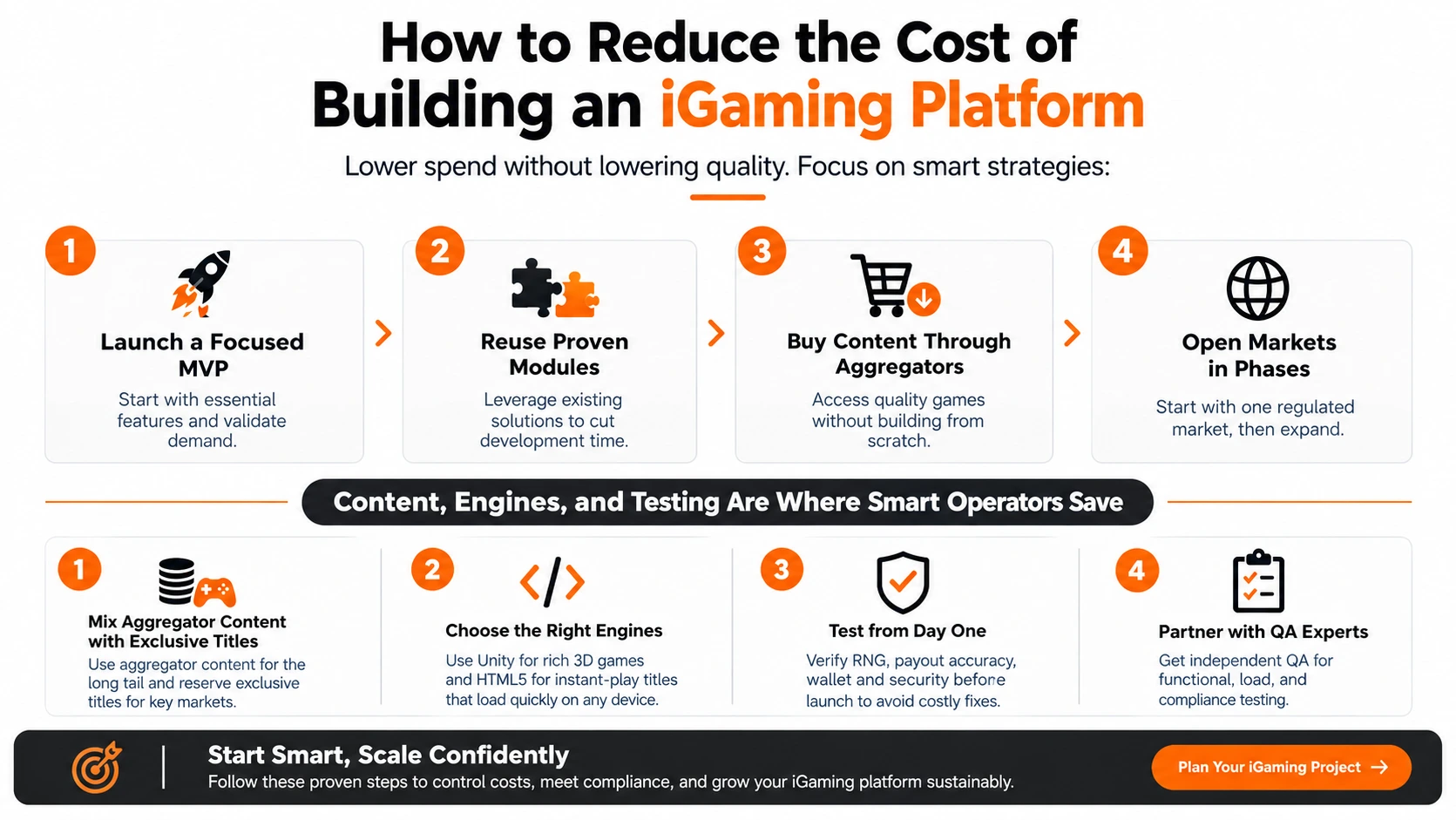
You can lower spend without lowering quality by sequencing decisions. Four levers matter most: launch a focused minimum viable product, reuse proven modules, buy content through aggregators, and open markets in phases.
Each tactic moves cost from a large upfront commitment into smaller, evidence-based steps. That also reduces the risk of building features that players never use or regulators later reject.
Content, Engines, and Testing Are Where Smart Operators Save
Mix aggregator content with a small set of exclusive titles. Unity game development suits rich 3D and cross-platform titles where visual differentiation drives retention. Reserve it for flagship games rather than the whole catalogue.
The rest of the library can be lighter. Instant-play titles load quickly in a mobile browser, need no download, and are simpler to update across all devices. That makes HTML5 game development a practical default for the long tail of slots and table games.
Budget testing from day one rather than treating it as a final gate. Certification bodies test random number generation, payout accuracy, wallet reconciliation, and security. Failures found after launch cost far more to fix than failures found in staging.
Independent QA services that cover functional, load, and compliance testing protect both the launch date and the licence. Finally, open one regulated market first, prove retention, then expand.
Choosing a Gambling Software Development Company
The vendor you select affects cost more than any single feature. A capable partner prevents rework, accelerates certification, and shares regulatory knowledge you would otherwise buy through mistakes. Evaluate candidates on delivered iGaming projects, not slideware.
Ask for reference clients who have passed licensing audits. Four criteria separate strong partners from generic software agencies, and you can use them as a scoring sheet during procurement.
1. Portfolio, Licensing, PAM Expertise, and Support Matter Most
Portfolio depth shows whether a team has shipped real-money products. Licensing experience shows whether they know certification pathways in your target jurisdictions. PAM and wallet expertise matters because those modules carry the most risk. Post-launch support matters because live platforms need patches, monitoring, and new content every month.
If slots are central to your plan, ask whether the partner also operates as a slot game development company, because in-house content shortens launch timelines. Then compare proposals on total cost of ownership rather than headline price.
2. Request Module-Level Quotes and Exclusions
Ask for a module-level quote, an explicit exclusions list, and a named schedule of third-party fees before shortlisting vendors. Vendors who cannot break pricing down usually cannot control it either. A transparent gambling software development company will do this willingly and will explain how its estimates change if scope shifts.
Finally, check post-launch terms. Ask about service-level agreements, security patch timelines, content roadmaps, and how handover works if you later bring development in-house. Clear answers here usually predict a smooth first year.
Concluding Note
Planning your iGaming platform development cost means pricing three things together: the build model, the product scope, and the jurisdiction. White-label launches fast for $14K-$146K, custom ownership costs $216K-$1.08M+, and recurring data, licence, cloud, payment, and audit lines continue long after go-live.
The strongest budgets start narrow, protect the wallet and PAM architecture, and expand verticals only after retention is proven. Use the ranges here as planning inputs, then validate them with module-level quotes from a partner who has shipped licensed products.
Market estimates and vendor price lists vary, so treat every figure as a starting point for due diligence, not a final quote. If you are comparing models for your own launch, talk to our team about a scoped estimate that matches your market and timeline.
Frequently Asked Questions
1. How much does it cost to build an iGaming platform in 2026?
White-label setups cost $14K-$146K and launch in 2–8 weeks. Custom builds start near $216K, can exceed $1.08M, and take 12–18 months. Turnkey sits between at roughly $81K-$270K+. These ranges exclude licensing, data feeds, and recurring operational costs.
2. What is the cheapest way to launch an iGaming platform?
A white-label deal is the lowest upfront path, typically $14K-$146K with launch in weeks. The trade-off is revenue share (10–25% or more) and limited differentiation. Anjouan licensing is also cheaper than Malta or Curacao, though banking and payment access may be harder.
3. What are the core features that drive iGaming platform cost?
Five modules absorb most engineering: PAM with KYC ($25K-$80K), wallet ($20K-$60K), bonus engine ($15K-$50K), game aggregator integration ($10K-40K), and admin back office ($30K-$90K). These total $100K-$320K and sit within the custom build range once architecture, integration, certification, and testing are added.
4. What recurring costs should I budget after launch?
Data feeds $3K-$18K per month, gaming licences $1.5K-$6K per month, cloud hosting $2.5K-$10K per month, payment processing 2.5–5.5% of volume, compliance audits $10K-$25K per year, and marketing, which is often the largest and most variable line.
5. Which is more profitable: casino or sportsbook?
Casino margin is roughly 2–4% per action but generates high volume and predictable revenue. Sportsbook margin is higher per event but depends on the sporting calendar. Many operators use sportsbooks as an acquisition channel and casino as the profit engine.
Ready to Plan Your Casino, Sportsbook, or Multi-Vertical iGaming Platform?